When the AI Liability Underwriter and the Inland Marine Specialist Must Work the Same Robot Fleet File
How to coordinate AI liability and marine cover on one fleet.
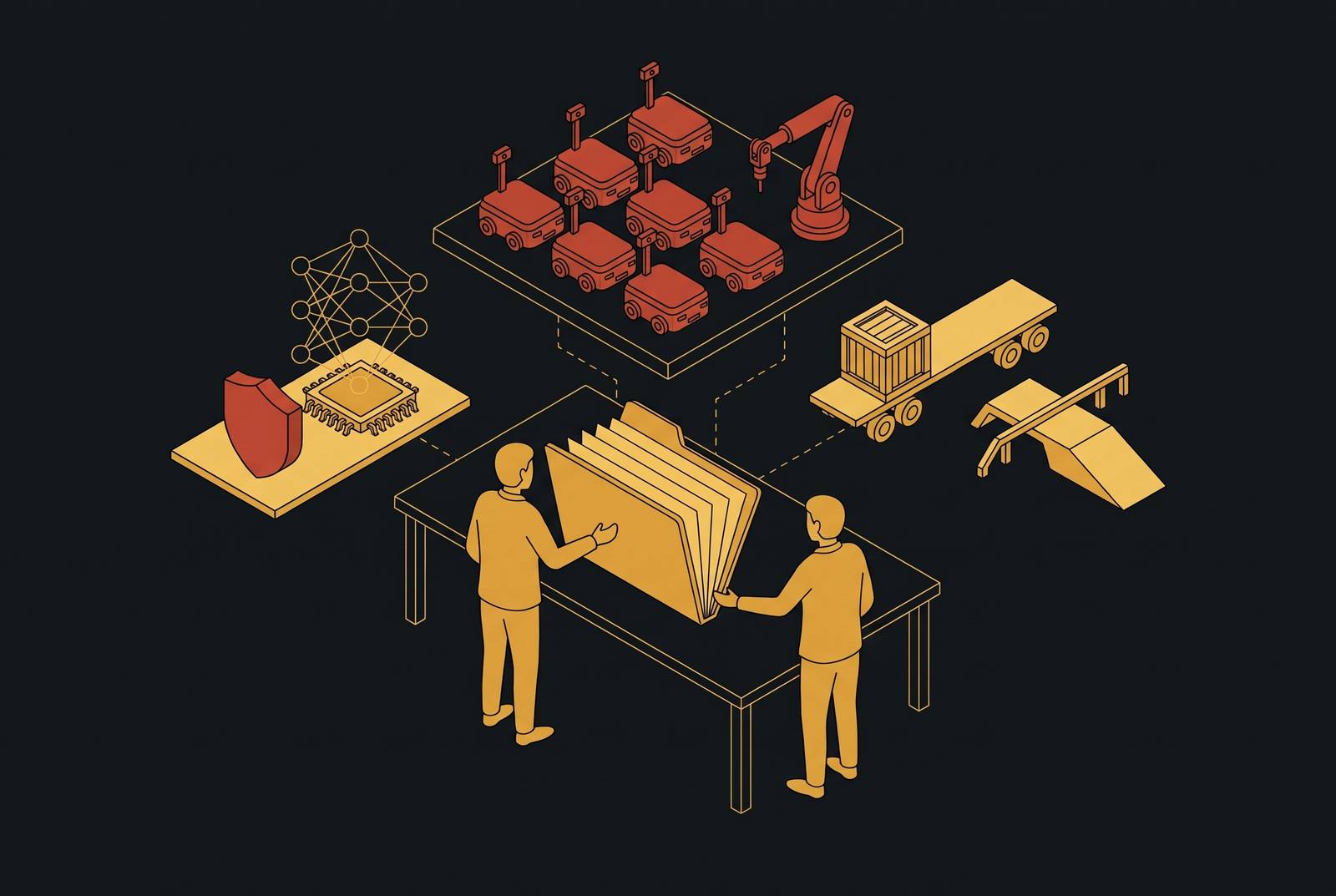
Inland marine coverage for deployed robot fleets should use a scheduled equipment floater that fits each unit’s value, the territory where it operates and the conditions for its customer-site deployment and transit. It covers the physical asset exposure. A fleet therefore needs coordinated AI liability and inland marine underwriting, with the boundaries agreed before binding to avoid disputes after a loss.
Why a robot fleet file cannot be handled by a single underwriting desk
Insurance markets separate a robot’s behavior from its physical existence. The AI liability desk evaluates what the system decides, whether that decision causes harm and who bears responsibility. The inland marine desk evaluates the hardware’s value, location and movement through the territory the carrier agrees to cover. These are separate legal and actuarial categories. They attach to the same machine, but the specialists evaluating them do not share the same appetite, vocabulary or authority.
WTW’s 2026 analysis illustrates how responsibility for harm can extend across multiple parties through a warehouse incident in which a humanoid robot drops a heavy object on a contractor. Responsibility can reach the manufacturer for design flaws, the software developer for algorithmic error, the operator for inadequate procedures and the maintenance provider for sensor failure. Each connection raises a different coverage question. Insurance for the robot itself is a separate property question, even when the same incident damages it. The account consequently requires more than agreement about whether the machine is safe.
What the AI liability underwriter is actually evaluating — and what authority they hold
The AI liability underwriter evaluates the chain of decisions behind a loss. A human-caused accident may present a legible sequence from driver to employer to insurer, while an autonomous-system accident draws in sensor reliability, software version history, training data quality and edge-case validation. The evidence is harder to present and interpret. Most deploying firms do not have those records in an underwriter-ready form, and most actuaries lack a clear basis for evaluating them even when they exist. That uncertainty shapes the terms available.
The market response has been defensive and exclusion-driven. ISO issued three generative AI exclusions for commercial general liability in January 2026, namely CG 40 47, CG 40 48 and CG 35 08. CG 40 47 broadly excludes Coverage A, covering bodily injury and property damage, and Coverage B, covering personal and advertising injury, arising out of generative AI. Regulators approved the large majority of major carriers’ AI exclusion filings, with exclusions in several states taking effect as early as January 2026. These are generative AI forms, so their relevance to a particular fleet depends on its technology and the policy language.
The liability desk decides whether those liability grants cover a loss, which AI-specific exclusions apply and what safety documentation it needs before binding. Its authority does not extend to scheduling the hardware, covering an unlisted customer location or insuring a unit in transit. California’s AB 316, effective January 1, 2026, bars defendants from asserting that the AI’s autonomous conduct, rather than the company’s own choices, caused the harm. That closes the “AI did it” defense and expands the exposure the liability underwriter must price.
How do you insure mobile robots operating across multiple locations?
The inland marine underwriter starts with geography and asset value. For a deployed fleet, the appropriate structure is a scheduled equipment floater, with each unit individually listed at its own stated value. The agreed/stated-value structure establishes the per-item basis for payment rather than leaving replacement to a depreciation dispute. The schedule is only half the answer. The policy must also match where the equipment operates and how it moves between locations.
Territory restrictions are a central underwriting lever and a practical trap. A contractor’s equipment floater can exclude equipment traveling across state lines or internationally, making a seemingly suitable form incompatible with a logistics or delivery fleet’s actual routes. Transit needs its own explicit coverage answer. The inland marine desk sets the insured-unit schedule, agreed values, covered territory and the conditions for transit, temporary storage and customer-site deployment. Listing a fleet on a schedule does not, by itself, show that every deployment meets those conditions.
The desk can evaluate damage to a robot, but it cannot settle what the operator owes an injured third party or resolve another policy’s treatment of an AI decision error. Software makes the boundary less stable. An update that causes navigation failure can leave damaged or stranded hardware while also disrupting customer operations or injuring bystanders. WTW’s analysis notes that a compromised robot can cause operational disruption, property damage and injury rather than simply lose data, eroding the boundary between cyber, operational and physical risk.
Where the two underwriters’ authority overlaps — and where disputes emerge on a shared file
If a navigation algorithm sends a robot into a rack, the damaged unit presents an inland marine question, while damage to other property may present a liability question. The cause is shared, but the insured interests differ. An AI exclusion in the liability policy does not itself determine the inland marine response. The dispute emerges when the relevant grants and exclusions have not been reconciled, leaving the operator without an agreed account of which policy responds to which part of the event.
A remote exploit that redirects a fleet can cause collisions or send units into areas where they are not allowed, so cyber, inland marine and AI liability coverage may each cover part of the event. Exclusions can point in the opposite direction. Reinsurers are also examining systemic scenarios in which a software fault affects large numbers of robots simultaneously. That accumulation concern encourages individual carriers to narrow their exposure, making an undefined boundary more consequential than it would be for an isolated equipment loss.
Customer-site injury creates a different overlap around responsibility. Workers’ compensation may respond for the customer’s employee, product liability may attach to the manufacturer and the operator’s general liability may become the contested middle ground. WTW identifies overlapping exposures across product, general, professional liability and cyber lines, while the parties responsible for making, programming, operating, owning and overseeing a cobot may all enter the liability chain. Insurance for the unit at that location is therefore not evidence that the operator’s third-party exposure is covered.
A single software update can change a fleet’s physical risk profile overnight, leaving machines operating on decision logic different from what the submission described. Traditional underwriting has no mechanism suited to that pace of change. Without an agreed approach to updates, deploying a system that differs from the disclosed system can itself become a coverage dispute.
How the submission must be built to satisfy both underwriters simultaneously
The practical response is a submission built around both disciplines and their shared boundaries. The liability part of the file should include software version documentation, a description of the safety control architecture, evidence of a safe-stop system, details of cybersecurity measures and a third-party safety evaluation. These documents explain the behavioral risk being offered. They should also identify the named standards under which the fleet operates, without presenting future underwriting expectations as current requirements. Koop’s IN BOTS WE TRUST 2026 maps ISO 10218:2025, R15.08, ISO 13482 and UL 4600, but predicts their role as formal underwriting inputs for 2027.
Safety evidence also affects the economic case presented to carriers. The report finds that companies reporting a named safety control pay materially less per dollar of revenue, yet underwriters credit a named standard or safe-stop in only a small fraction of reviewed submissions. The documentation gap has a measurable cost. Insurers are increasingly asking about AI use and controls, much as cyber applications developed questions about IT security. Strong governance can help a firm get better terms, while weak controls can lead to exclusions or higher rates.
The inland marine portion needs a complete unit schedule with stated values and a territory map covering every state and country of deployment. It should explain how long units stay at customer sites, the conditions in which they are deployed and whether the equipment crosses state lines. The schedule identifies what is insured, while the map and deployment description establish whether the proposed territory and conditions fit the operation. An accurate asset list cannot compensate for an excluded operating geography.
The shared portion must address policy response before claim time. It should set out which policy responds first to software-induced hardware loss and whether cyber coverage sits above inland marine as excess or leaves a gap because of competing carve-outs. Update and versioning cadence belong in that discussion. The file should also align customer-site certificate requirements with the actual liability and property terms, rather than treating the certificate as a substitute for coverage. The report identifies six documents that pre-empt nine in ten underwriting conditions, placing submission architecture at the center of the placement.
Why contract insurance requirements make the two-desk problem a commercial deadline, not a theoretical one
Enterprise and government buyers can require a certificate before equipment enters a facility, and a mismatch can prevent the deployment from proceeding. The contract clock does not wait for underwriting. Except for auto and workers’ compensation requirements, the obligation to buy robotics liability insurance generally arrives through contracts with customers, landlords, cities or defense primes. Procurement and legal teams specify limits and coverage types without organizing their requirements around separate underwriting desks.
Those demands start to come in more often around Series A, including enterprise contracts that ask smaller vendors for high cyber limits. A certificate showing AI liability coverage does not solve a requirement for customer-site equipment coverage if the deployed units remain unscheduled. The reverse is equally important for liability. A general liability certificate may seem to meet the terms of a contract for robotic operations even though the policy has a CG 40 47 exclusion that applies to those operations. The mismatch may remain unnoticed until a claim or a risk manager’s review.
California’s January 1, 2026 effective date and the EU directive’s December 9, 2026 date place concrete markers on the timetable. As Texas, Arizona, California and EU member states make their autonomous-system liability rules clearer, enterprise procurement teams are expected to write more specific requirements into MSA insurance clauses. A placement that satisfies today’s certificate request may therefore need further coordination for the next customer contract.
What a specialist broker actually does differently when both desks must share a file
A specialist broker ensures both desks can work from the same file when constructing it, before the carrier terms become a binding constraint. Standard commercial applications were not designed to surface software version cadence, territorial deployment maps, safe-stop architecture or stated-value unit schedules. Those omissions are not merely clerical shortcomings. They prevent each desk from evaluating its own exposure and obscure the points where the policies must connect. The broker’s work is to make those questions explicit rather than leave them for separate underwriters to discover.
That work includes reading both policies before binding to identify where the liability grant ends, where the equipment grant begins and whether the cyber boundary is defined or silent. Placement then requires carriers willing to cover autonomy. The liability desk needs the behavioral documentation, and inland marine needs the asset schedule and territory map, with a clear coordination-of-benefits structure for the areas where the policies overlap. The customer certificate must accurately show the coverage agreed, the territory it covers and the required limits.
The service also extends beyond initial placement because product releases can change the risk under review. As the submission is kept up to date, software versioning and feature-level detail must stay part of the coverage discussion so the account keeps pace with changes to its original description. The commission is already included in the premium. Whether a generalist or specialist places the policy, the commercial question is what that commission buys. For a deployed robot fleet, its value lies in maintaining an agreed boundary between the policies as machines move, contracts change and software evolves.