Inland Marine Policies That Actually Cover Deployed Robot Fleets
Standard forms don't account for machines that move autonomously and make their own decisions.
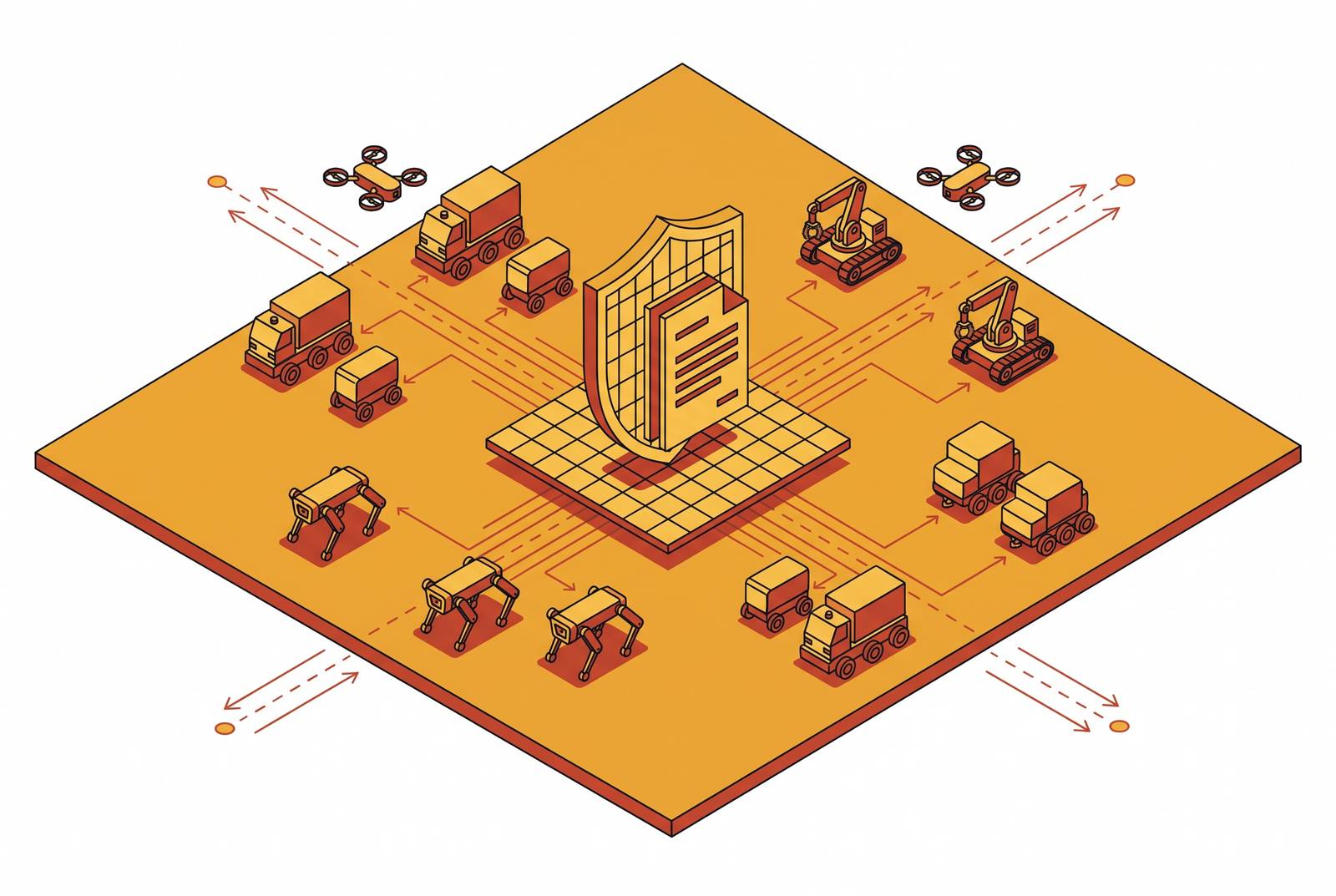
Inland marine coverage for deployed robot fleets must list what each unit would really cost to replace and cover the routes it takes, the customer sites where it works, and its operating conditions. It covers the robot as property. A policy that actually fits the fleet therefore depends on accurate schedules, coordinated liability coverage, and exclusions that do not remove the intended protection.
Why standard inland marine forms were not built for hardware that moves on its own
Standard inland marine forms imagine equipment sitting at a jobsite, waiting for someone to use it. A deployed robot moves through changing environments and makes decisions about what to do next, exposing the hardware to failures that can be partly mechanical and partly algorithmic. A form built for a contractor’s drill press or a rented generator does not describe those operating conditions.
The name is a holdover from cargo insurance, but the modern function is property coverage for equipment in transit, at jobsites, and on pilots and demos. Standard commercial property policies stop at a company’s own walls, so inland marine is the main coverage for hardware that leaves the premises. But its wording was written for equipment that people move. That distinction affects the scope of a claim. When a unit goes down in the field, coverage for the loss depends on the description of the equipment, the conditions of its deployment, and the policy’s exclusions.
What an inland marine policy must actually schedule for a robot fleet to be covered at replacement cost
The equipment schedule must describe the operational unit. For autonomous hardware, replacement cost includes sensors, compute hardware, proprietary mechanical components, software licenses tied to the hardware, and the integration work required to make a replacement operational. Those components must be documented as part of the insured asset. A generic description with an understated value does not represent the same property as a description of the complete machine.
This is a documentation problem before it is a valuation problem. The policy covers what its schedule says it covers, so even a substantial stated value is not a substitute for an accurate equipment description. Those values matter for pilot agreements for machines left at customer sites and for the company’s own balance sheet. An undervalued schedule leaves a replacement-cost gap uninsured regardless of the broader coverage language.
Units added at new sites and machines on temporary pilots may start work between renewals. The form must therefore allow scheduled items to be added mid-term.
How inland marine covers autonomous robots traveling between job sites and operating across multiple locations
A robot crushed in transit, dropped from a loading dock, or hit by a forklift at a customer site has suffered a property loss. Whether that loss is covered depends on the form’s treatment of the location, transit leg, and mode of movement. Off-premises coverage is not necessarily unrestricted geographic coverage. Standard forms often confine it to named locations or specific transit corridors, which can leave a fleet’s actual movements outside the insured territory.
The operating envelope also changes with the platform. Autonomous mobile robots work in warehouses, while sidewalk units move through municipal zones and field robots work in agriculture or construction. A single generic form needs specific endorsements to cover all three. The coverage has to describe where the hardware works as well as how it gets there.
A machine left on a long-term pilot occupies a site the operator does not control, potentially at a location that was not listed when the policy bound. Coverage for a trip to that site does not establish coverage for an extended deployment there. The form must clearly cover the third-party premises where the robot works and its deployment conditions. Otherwise, the location where the robot spends its working life may be outside the protection purchased for it.
Where inland marine ends and general liability must begin when a robot causes harm
Inland marine covers the robot itself if it is physically lost or damaged. When the machine injures a person or damages a customer’s property, the exposure moves to general liability. These are different losses, even when they arise from the same malfunction. The program must account for the machine both as an asset that can be damaged and as equipment capable of causing harm.
General liability is the line intended to respond to bodily injury and property damage caused by the machine operating in the field. Site owners often ask for proof before letting a unit through the gate because they expect that policy to cover those claims. Its description of the operation and its exclusions are therefore as consequential as the inland marine schedule. A fleet can be accurately valued and covered at every deployment site while its operating exposure remains poorly insured.
A California court previously found that drone incidents were not covered under a standard commercial general liability policy because of its aircraft exclusion. That is a concrete boundary between policy lines. For drone deployments, separate aircraft or aviation-specific liability coverage is necessary rather than an optional extension of equipment insurance. The aircraft finding should not be treated as a rule for every ground-based autonomous vehicle. Its significance is that a policy labeled general liability can exclude the very platform creating the liability exposure.
What happens to inland marine and general liability coverage when an AI exclusion is attached to the policy
The endorsement schedule is where an AI exclusion becomes part of the policy, potentially narrowing protection that otherwise appears to fit the fleet. Accurate equipment values, appropriate locations, and coordinated liability coverage do not override an attached exclusion. The endorsement wording governs the affected exposure.
ISO introduced generative-AI exclusion endorsements CG 40 47, CG 40 48, and CG 35 08, effective January 1, 2026, for commercial general liability policies. These forms give carriers a means to exclude generative-AI-related losses. Their stated scope should not be confused with all autonomous operation, since an autonomy stack does not necessarily use generative models. Nor are these named CGL endorsements evidence of an exclusion on an inland marine policy. The wording attached to each property and liability form must be checked on its own.
W.R. Berkley filed independent language targeting “any actual or alleged use of AI” across D&O, E&O, and fiduciary liability lines. That scope reaches the autonomy stack regardless of whether it uses generative models. A fleet’s intended coverage can be narrowed across its program, but the line affected and the breadth of the restriction must be established from the actual endorsement.
What the rest of the coverage stack must do when inland marine and general liability alone are insufficient
Tech E&O addresses a different exposure when the autonomy stack is itself the product. A perception model licensed to a fleet, a navigation service, or a control policy running on a customer’s hardware can create a software-caused loss for which general liability may not respond. Ownership of the damaged machine does not resolve that exposure.
Cyber coverage addresses a loss originating in a network event, where an attack takes over a robot’s controls and makes the machine an instrument of physical harm. That origin distinguishes the coverage need.
Umbrella coverage adds limits above the primary policies, usually when an enterprise master service agreement or site owner calls for more than the primary policy provides. Workers’ compensation covers the technicians who install, service, and supervise machines in the field. It is legally required in most states once a company has employees, and field work produces claims more frequently than desk work. Extra liability limits do not replace software coverage, and equipment insurance does not replace protection for the people servicing the fleet.
What enterprise and government contracts demand from a robot fleet operator’s insurance program
Enterprise and government contracts turn insurance design into a condition of doing business. Commercial general liability is the baseline in almost every commercial contract, and large enterprise customers frequently require limits above a standard primary policy. Those requirements have been rising. A program that met contract terms a few years ago may therefore fall short when a new deployment is ready to close. The commercial obstacle is immediate, even if the fleet has not yet suffered a loss.
The contractual requirements extend beyond limits to additional insured endorsements, waivers of subrogation, primary and non-contributory wording, and certificates of insurance. To meet each requirement, the underlying policy must be set up correctly ahead of time. Contractual indemnification creates a separate constraint on recovery. Standard AI vendor agreements often cap total liability, including indemnification, at twelve months of fees. That amount can be a small fraction of the damages from a serious incident, leaving an exposure that the existence of a vendor agreement does not resolve.
A certificate of insurance documents the policy and its limits, but it does not show what the policy excludes. The distinction can be easy to miss. A customer reviewing the certificate cannot see an attached CG 35 08 endorsement or assess its effect on the proposed deployment. An operator can thus meet the certificate requirement even though the policy excludes the AI-related claim from that work. Contractual proof of insurance and coverage for the contracted operation are not the same thing.
Why the underwriting submission determines whether an inland marine policy for a robot fleet will actually respond
A standard commercial insurance application has no fields for supervision models, operating envelopes, geofencing, emergency stops, or safety cases. Without those details, an underwriter has little basis for distinguishing an autonomous system from rented construction equipment. The resulting quote may include a higher premium, broader exclusions, or a decline. The submission is the intervention point for giving the underwriter the information needed to evaluate the actual operation.
A submission that describes supervision ratios, emergency stops, and incident logs translates safety engineering into terms an insurer can assess. That description can produce materially different terms from an application that simply says “autonomous.” Historical data cannot yet do all the work. Actuaries rely on claims history, but robotics is both nascent and fast-moving, and relevant loss data does not exist at scale.
Observability also connects the submission to later claims and renewals. Carriers in existing programs require immutable logs of autonomous actions so forensic investigators can distinguish a prompt injection attack from a training data flaw or an environmental anomaly. Establishing that practice at binding prepares the evidence for a claim defense. It does not promise that a loss will be covered. The policy must still describe the right assets, deployments, and exposures without exclusions that defeat the intended protection.
The practical response is to work with a specialist broker who reads the policy before it binds, describes the operation in terms carriers recognize, and routes the submission to underwriters seeking autonomous hardware risks. That preparation differs materially from completing a generic application. The broker’s commission is already embedded in the premium either way. Specialist preparation makes the submission the place where coverage gaps can be addressed before they become part of the bound policy.