Coverage Triggers for Robots Damaged in Transit Between Job Sites
Inland marine is the coverage line designed to follow robot fleets between job sites.
Inland marine is the property coverage line designed for deployed robot fleets moving between job sites, but a transit claim depends on the policy’s loading and unloading language, covered conveyances, scheduled or blanket structure, and cause-of-loss basis. Standard fixed-address property coverage is not designed to follow that journey. The practical safeguard is to match those terms to the fleet’s actual movements before deployment.
Why transit is the riskiest moment in a robot's working life
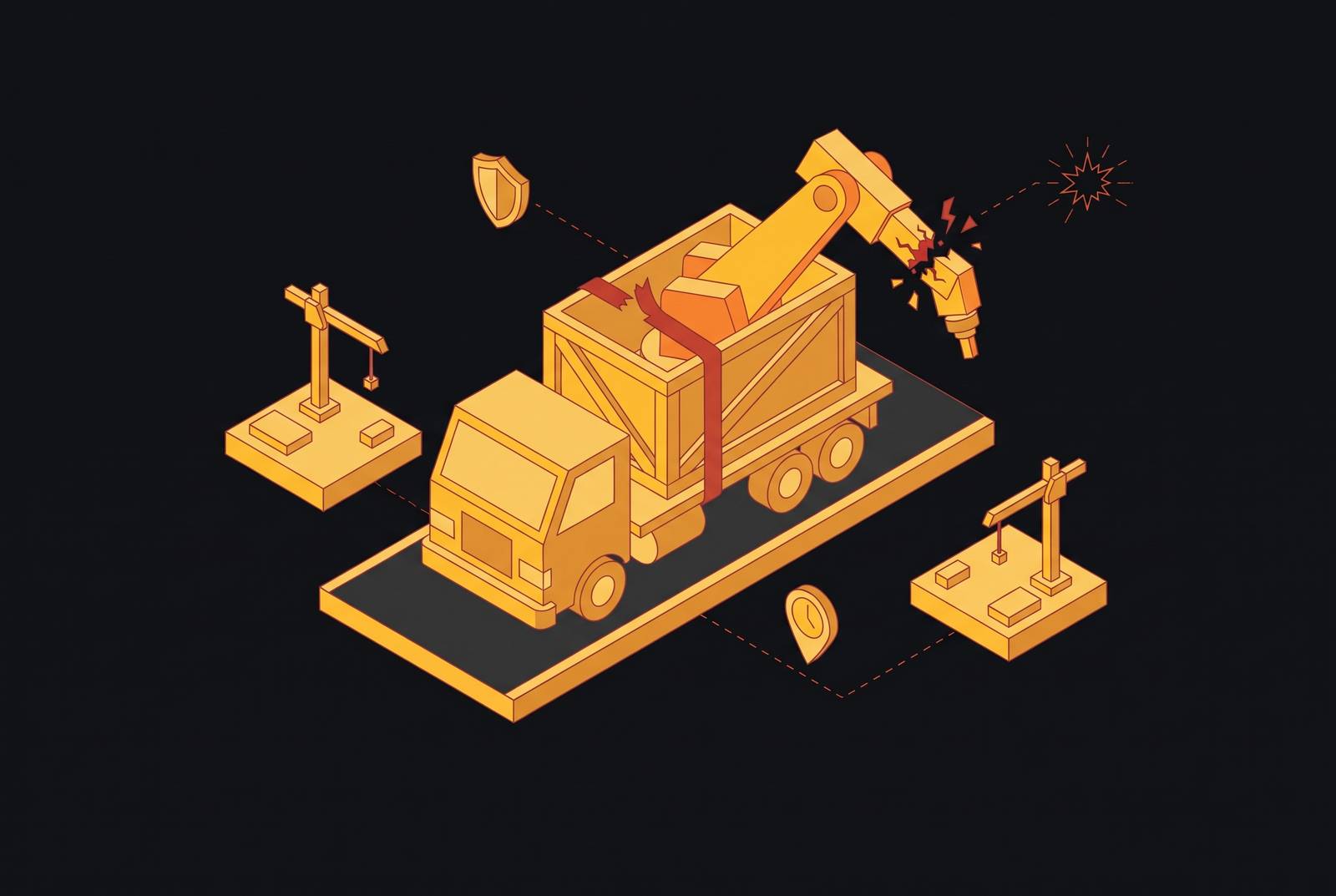
A crated robot is being offloaded at a job site. It can be dropped from the dock, struck by a forklift, or crushed before it begins work. The machine may represent months of build time, and damage can delay the deployment as well as destroy hardware. The loss is physical before it is financial.
That journey changes the robot’s risk profile. Once it leaves its home facility, a high-value asset moves through places the company does not control. Software companies’ claims are mostly financial, while robotics companies need coverage for damage to the machine itself. Insurance that covers property at an address may leave working hardware uncovered in transit.
Why a standard property policy stops at the company's own walls
Standard commercial property policies are written around a fixed, scheduled address. Their geographic boundary is part of the coverage design. When a robot loads onto a truck and leaves that location, the company cannot assume that its premises coverage follows. The asset still belongs to the company, but ownership alone does not extend the policy’s territory.
That distinction can leave a substantial balance-sheet asset uninsured between deployments. A company may have property insurance for the facility where it builds or stores robots and still have no applicable coverage for damage on the road. The coverage gap follows from the form itself. A policy written for assets that stay at a location does not become mobile-equipment coverage simply because the insured begins sending those assets to customers.
The solution therefore requires more than recording the robot’s value under the premises policy. It needs a coverage line for equipment that moves and works off-site. Inland marine addresses that different exposure. Its purpose is to follow equipment beyond the company’s walls, subject to the locations, movements, and losses its wording actually covers.
What inland marine covers for deployed robot fleets
Inland marine is property coverage for gear that moves as part of its work, covering it in transit, at job sites, and on pilots and demonstrations. For mobile robotics, that is the relevant distinction. A robot can leave home base, work at a customer’s location, and spend time in third-party storage, so its insurance needs to account for more than the road journey.
Autonomy.insurance describes robot hardware coverage that explicitly includes damage in-transit, on-land, and during storage at a third-party premise. Those named scenarios show how a specialist program can recognize the machine’s different locations. They also give a buyer concrete wording to look for. The presence of an inland marine policy alone does not establish that every stage of deployment is included.
The policy’s asset structure is equally important. Scheduled coverage lists each unit at its replacement value, while blanket coverage has one limit for the whole fleet. Scheduling gives the clearest starting point for a transit claim because the damaged unit’s identity and value are recorded when coverage binds. A blanket form without a per-unit schedule leaves more room for disagreement about which machine was insured and at what value.
The specific triggers that determine whether a transit claim pays
The first trigger is loading and unloading coverage. Check when the covered transit period begins and ends, because some forms begin only once the unit is moving on a conveyance. Damage at a dock or ramp can fall between policies. The property policy may no longer apply while the inland marine coverage has not yet activated, leaving a loss during loading outside both. A well-drafted inland marine form expressly extends coverage to loading and unloading.
The second trigger is the covered conveyance type. Check whether the form specifies common carriers, company-owned vehicles, flatbeds, or other means of transport, and compare that definition with actual shipping practices. Not every vehicle necessarily qualifies for coverage. A contractor’s van or rented trailer may fall outside a form that otherwise covers the robot in transit.
The third trigger is the scheduled or blanket structure. Check whether the insurer can identify the damaged unit and establish its insured value from the policy. Under scheduled coverage, the unit and its replacement value are already listed, but with a blanket form that has no per-unit schedule, those points can still be in dispute after damage occurs. Both forms are meant to insure mobile equipment, but this difference can make the claim clearer.
The fourth trigger is the cause-of-loss basis. Check whether the form covers named perils or uses an open-perils basis. Named-perils coverage responds only to listed causes, such as fire, theft, and collision, while open-perils coverage responds to causes not expressly excluded. The distinction is consequential for sensitive robot hardware. Vibration or pressure damage may not fit a named-perils list, so a policy that covers a collision may not cover damage sustained during an otherwise uneventful journey.
How AI exclusions in standard policies compound the transit gap
The location and transit terms are not the only wording that can change coverage. AI exclusions can be added as endorsements when the policy renews, without the company choosing to buy a separate policy. That makes renewal documents part of the coverage review. A company that relies on what it knew about the program before may miss a new exclusion for property damage.
ISO issued new generative AI exclusions for commercial general liability in January 2026. Endorsement CG 35 08 excludes bodily injury and property damage arising out of generative artificial intelligence under the Products/Completed Operations Coverage Part. Its scope needs to be read precisely. The description does not name autonomous systems, robotics, or AI-directed physical operations, so it does not establish that most robots fall within the exclusion merely because they operate autonomously.
The distinction between liability and hardware coverage is also essential. An exclusion for property damage under a liability coverage part is not, by itself, an exclusion under an inland marine policy covering the insured’s own robot. The broader exclusion wave makes document review more urgent, but it does not justify treating every AI endorsement as a transit exclusion. For a damaged machine, the practical test is whether an endorsement applies to the relevant coverage and whether its definition reaches the system or cause of loss involved. Reviewing endorsements added at renewal is therefore a necessary companion to reviewing the transit terms.
What the emerging specialist market shows about what coverage should look like
Specialist programs show that coverage can be built for equipment that moves. Their relevance is structural, not simply a different product label. They account for robots that move between customers, work away from premises the insured owns, and may need to be replaced after damage.
The People's Insurance Company of China has covered Sharebot’s robots since December 2025 without needing a fixed address where they work within the Chinese mainland. The policy covers damage to the machine and third-party liability. Because the machines move between customers, the absence of a fixed-address requirement addresses a basic feature of the operation.
Tokio Marine & Nichido announced that it will introduce AI robot insurance in November 2026. The announced coverage will cover equipment damage from collisions and natural disasters, third-party liability, and business continuity costs, including wages for replacement workers and fees to rent substitute robots. This is an announced introduction, not evidence of current availability. Its structure nevertheless illustrates a broader view of the insured asset, recognizing that a damaged robot’s absence can interrupt work as well as create a repair or replacement cost.
The hardware scenarios described by autonomy.insurance make the transit element explicit. In-transit damage and third-party storage are named parts of the coverage description, rather than risks a buyer must infer from a general equipment label. These examples are not interchangeable policies. Together, they show the kinds of operating details a specialist program can address, while leaving the buyer to establish which protections appear in the actual contract.
Why underwriting submission quality decides whether inland marine terms are workable
The submission gives an underwriter the information needed to turn that coverage structure into workable terms. Limits, cause-of-loss scope, and loading and unloading language depend heavily on how the risk is presented. A generic description leaves too much unresolved. Calling a robot “mobile equipment” without explaining its operating envelope, transit patterns, conveyances, and safety architecture can place it on a rate page designed for conventional construction equipment.
A useful submission makes the four transit triggers concrete. A written account of how robots are loaded and shipped explains the risks during those steps, and details of each conveyance show which vehicles the form needs to cover. Per-unit replacement values support the schedule. An account of how the units travel also gives the underwriter context for the requested cause-of-loss scope, instead of leaving the fit between the form and the journey unexamined.
Underwriters who assess autonomous-system risk also look at architectural maturity, operating controls, and the safety practices the company has put in writing. Historical loss data does not exist at scale for this asset class, so the submission cannot rely on claims history alone to explain the exposure. The operating description becomes a central underwriting input. It shows what the system does and how the company controls its use, rather than asking the underwriter to price an unfamiliar machine from a broad equipment category.
The policy still needs review before it binds. A specialist broker can compare the proposed loading and unloading language, conveyance scope, and cause-of-loss basis with the operating pattern described in the submission. A generic placement of a standard form does not substitute for reading whether the coverage actually matches the fleet’s movements.
What to check in an existing policy before the next deployment
First, check the start and end of covered transit. The wording should address the loading and unloading sequence as well as the period when the unit is on the conveyance. Dock and ramp handling need an explicit answer. If the policy starts later or ends earlier than the physical movement, the company needs to identify that gap before shipping.
Second, check the definition of covered conveyance against every type of vehicle the company uses. That includes common carriers, company-owned trucks, contractor vehicles, and rented trailers where those form part of the operation. Do not infer permission from a general transit label.
Third, check whether each unit is scheduled for what it would cost to replace it now. A blanket fleet limit without a per-unit schedule can leave identity and value disputed at claim time. Fourth, establish whether the form is open-perils or named-perils. Vibration, pressure, and mechanical shock may be absent from a named-perils list, while an open-perils form covers those causes unless it expressly excludes them.
Fifth, check the AI exclusion endorsements added when the policy last renewed. Determining whether an exclusion could affect damage to the robot requires reading the applicable coverage part and the endorsement’s definitions. The label alone is not a coverage determination. A licensed broker should read the policy itself against these five points before the next deployment.
That specialist review does not require a separate cost beyond the premium. The broker’s commission is baked into the placement regardless, so there is no financial reason to accept a generic form when a purpose-built one is available.