How AI Model Liability Exposure Changes the Inland Marine Scheduling Logic for Multi-Site Robot Fleets
Hardware schedules miss what a robot's AI can decide, and that gap is widening.
Inland marine coverage for deployed robot fleets follows hardware off-premises, including between job sites, but a hardware schedule alone does not cover all the risks of autonomous operation. Multi-site fleets need scheduling that sets out the AI model’s decision scope, update procedures, and operating permissions, along with coverage triggers for AI-driven losses. The central distinction is between insuring the machine and insuring what it can decide to do.
Why standard inland marine scheduling logic was never designed for autonomous robots
Standard inland marine scheduling lists equipment by its serial number, location, and replacement value. Its underlying premise is that these details describe a reasonably stable risk as the equipment moves between sites. That holds true for deterministic equipment whose work stays predictable. It does not adequately describe a machine that uses sensors, software, and AI models to choose how to act as conditions change.
A physical AI system uses its model to make decisions that affect the environment around it. The hardware identifies the unit, but it does not fully describe the actions that unit can take. A schedule can therefore remain accurate as an inventory while becoming incomplete as a description of exposure.
Site conditions make this mismatch concrete for fleet operators. The same robot can present materially different risks in two warehouses because floor layouts differ and workers interact with it differently. Its software version can also change after the policy is written. Neither the serial number nor the replacement value shows how those changes affect autonomous behavior. Location records where the machine works, but not the decision boundaries under which it works.
This leaves the conventional schedule describing the wrong constant. It treats the physical unit as the stable object of underwriting, even when the model and operating environment determine much of its risk. The unit remains identifiable throughout its working life. Its capacity to cause loss, however, cannot be inferred from that identity alone.
The three specific points where inland marine scheduling logic misfires on an AI-driven fleet
Valuation is the first failure because hardware replacement cost does not capture AI model value or model-driven changes in exposure. The embedded model may generate both the machine’s commercial value and its liability. Yet a software update can change its decision boundaries across the fleet without changing any declared equipment value. The inventory remains correct while the risk changes.
Liability attribution is a separate failure of the framework. A robot maker may supply the hardware, another company may develop the model, and the operator may be responsible for enforcing operating rules. Contracts divide those duties, but an incident can still produce a dispute over which failure caused the loss. A defective third-party sensor can trigger a failure while the claim lands on the company that integrated it. A per-unit equipment entry has no mechanism for representing that liability chain, and neither of the specialist products discussed below covers the full chain.
Coverage triggers create the third and distinct failure. A software update or sensor fault can take a robot offline and interrupt production without causing physical damage. That loss may not satisfy conventional physical-damage language or the policy’s definition of an accident. Standard business insurance may also exclude it through an AI endorsement. Recognizing the equipment’s value and identifying the responsible parties does not resolve whether the event activates coverage.
These failures occur together, but require different answers. A model update can alter the exposure being valued, complicate responsibility among the developer and operator, and cause a loss without the physical damage a policy requires. Increasing the scheduled hardware value would address none of the latter questions. Clearer contracts also cannot add a coverage trigger that the policy lacks. Treating these as independent paperwork defects leaves the underlying mismatch intact.
How the ISO AI exclusion wave removes the coverage most operators assumed they had
ISO released three optional endorsements effective January 1, 2026, that let carriers expressly exclude generative AI losses from standard Commercial General Liability policies. Majority regulatory approval was already in hand. The exclusion wave is therefore an existing renewal issue. Because the endorsements are optional, their effect depends on the forms a carrier adopts and attaches. A fleet operator renewing standard CGL coverage may be renewing into an express exclusion for a loss it expected that policy to absorb.
The broad exclusion removes bodily injury, property damage, and personal and advertising injury arising from generative AI, reaching both Coverage A and Coverage B. A narrower form excludes personal and advertising injury while leaving Coverage A intact. A separate form applies to the Products/Completed Operations Coverage Part. These distinctions prevent a generic reference to an “AI exclusion” from adequately describing what remains insured.
CG 35 08 is especially consequential for delivered systems. It removes bodily injury and property damage coverage arising out of generative AI under the Products/Completed Operations Coverage Part. For a company embedding generative AI in delivered hardware or software, that can remove the coverage most naturally associated with a robot damaging a customer’s property. ISO’s scope here is limited to generative AI. Whether that exclusion reaches a particular fleet loss depends on the system and the applicable wording.
W.R. Berkley went further than ISO’s generative-AI scope by filing absolute exclusion language for any actual or alleged use of AI in D&O, E&O, and fiduciary liability lines. Those filings concern different lines, but demonstrate that exclusion language need not stop at generative AI. A policy without one of these endorsements may still fail to respond because the loss does not satisfy its insuring terms.
What the multi-site dimension adds: accumulation risk and the limits of per-location scheduling
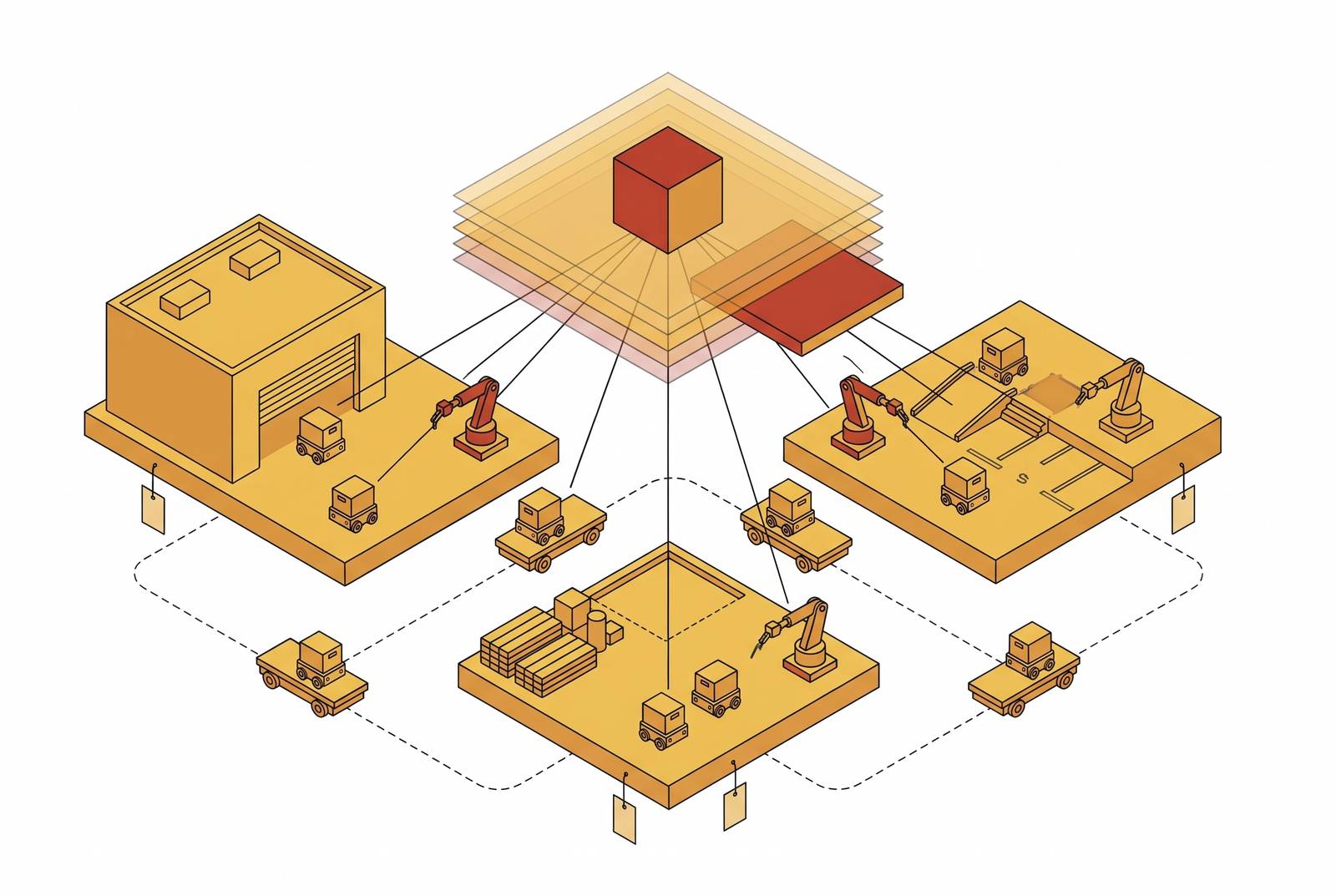
A shared AI model links exposures that a location schedule presents separately. A flaw in a widely deployed model can propagate to every unit running it, across locations and industries at once. Geography does not bound that common cause of loss. Unlike a fire limited to a site or a hurricane bounded by landfall, the model creates an accumulation exposure through shared deployment.
Per-location scheduling records each location as a distinct risk object, even when a centrally updated model governs robots throughout the fleet. An update can change the risks across dozens of customer sites while the declared locations and equipment entries stay the same. The schedule shows where assets are distributed. It does not show which assets share a decision system capable of producing correlated losses.
Floor layouts, worker interactions, software versions, and operating limits can change how a model behaves at each warehouse. Those variations coexist with the common model dependency rather than turning each site into an independent risk. Underwriting must account for both how work differs from site to site and how shared software links those sites. Otherwise, the spread of sites can hide the fleet’s accumulation.
Gallagher Re found that product liability coverage may respond to AI-related injury and property damage only in jurisdictions that treat AI software as a product. Financial losses from the same failure receive no coverage under that analysis. A fleet that works across jurisdictions can depend on the same software yet face different coverage for the same failure. The cyber insurance comparison is instructive here. Adoption similarly outpaced understanding of how technical risk translated into insured loss, leaving accumulation difficult to assess as claims experience developed.
How trace-level underwriting and model-aware scheduling address what conventional schedules cannot
The alternative is to attach underwriting to the model’s decision boundaries as well as the physical unit. When Agent Automation Becomes Profitable: Quantifying and Insuring Autonomous AI Risk through Trace-Economic Underwriting proposes mapping tool-use traces to customer exposure and claimable loss. Its unit of analysis is a bounded customer-task-trace episode. That changes what is being priced and controlled. Underwriting addresses what the agent is permitted to do during a task and what loss those actions can produce.
The research uses deterministic economic labels rather than model-generated judgment to price trace episodes. It frames automation as economically acceptable when the expected benefit exceeds the premium, control cost, and remaining risk. It also reports that trace-conditioned controls measurably reduce tail-risk exposure in real agent deployments. Policy wording remains necessary when applying this proposed underwriting method. Its practical contribution is to connect observable agent activity to financial exposure without assuming that every loss begins with physical damage.
For operators applying this approach, declarations should identify scheduled AI systems and scheduled agentic functions, including approved tools, connectors, and external-state permissions. Model scope becomes an explicit coverage boundary. Declared update procedures then address how that scope can change, rather than allowing a low-risk assistive model to drift silently into a high-risk autonomous agent. Documentation of training datasets and validation boundaries gives underwriters a basis for assessing the system within its stated operating envelope.
Underwriters require continuous tracking, automated intervention mechanisms, and audit logs that demonstrate deterministic safeguards. These records form the proof architecture used to assess the risk and support a claim. They make it possible to relate actual operation to the functions and limits described in the underwriting file.
Armilla AI Liability, backed by Chaucer, launched April 2025 with affirmative coverage for underperformance, hallucinations, or inaccuracies causing damage. Its standalone third-party AI liability trigger is based on how the AI behaves and does not require a security breach. Axis Insurance built an autonomous robotics program that covers production losses when a software update or sensor failure takes a robot offline, even without physical damage. Because these offerings cover different causes of loss, affirmative AI liability and non-physical-damage interruption coverage cannot stand in for each other.
Why submission quality is the operative variable when scheduling an AI-driven fleet
The underwriting submission is where model-aware scheduling becomes a coverage proposition a carrier can assess. Serial numbers and replacement values still describe the equipment, but cannot stand in for the model’s decision scope, update procedures, and operating envelope. A carrier cannot price or define the proposed autonomous functions from an inventory that never names them.
Insurance syndicates explicitly demand training-dataset documentation and validation boundaries as part of the underwriting file. These are inputs to pricing and coverage scope. Policyholders must also demonstrate continuous telemetry and automated intervention mechanisms. Missing architectural proof can produce outright denial or prohibitive premium penalties.
The Bot Auto / Marsh autonomous trucking program shows how to build a submission around real-time, data-driven risk assessment. Its coverage spans auto liability, property, general liability, cargo, and inland marine. The significance is the program’s treatment of operational data as a basis for terms that generic submissions cannot reach. Inland marine works alongside the other lines in that broader arrangement. For deployed robots, the same distinction separates coverage for the moving hardware from coverage for the consequences of autonomous operation.
The lesson for operators is to place the submission with carriers able to underwrite the declared AI functions, using specialist brokers who understand model-aware scheduling. Those brokers know how to build a submission in ways that generic forms cannot support. Broker commissions are already embedded in the premium regardless of which broker places the policy, so specialist placement adds no cost beyond a generic placement on that basis. The controllable variable is the underwriting file. The file helps turn what the fleet is allowed to do, how its software changes, and what controls support it into clear terms of coverage.