How AI Model Liability Interacts With the Inland Marine Form When a Robot Fleet Operates Across Client Sites
Inland marine and CGL both leave the robot's AI decisions uncovered.
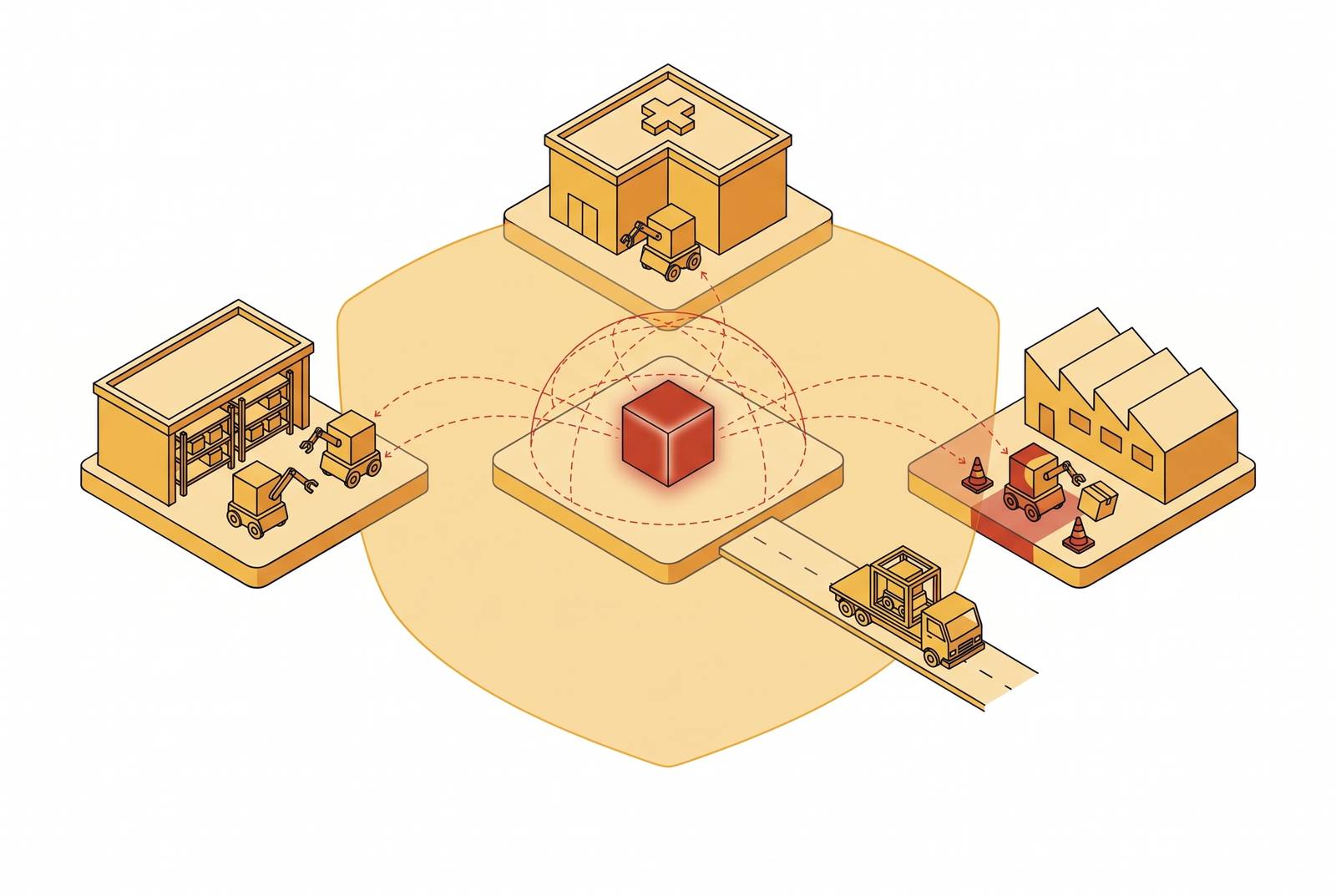
Inland marine coverage for deployed robot fleets follows the hardware as it travels between client sites, while commercial general liability addresses third-party bodily injury and property damage. Neither form was built for the AI model that directs the machine. To insure an autonomous fleet, coverage must reach the decisions its software makes, and the underwriting submission must describe how the fleet works.
Why the standard two-form program was never designed for a robot fleet at a client site
A robot fleet works at several client sites, with certificates of insurance already in hand. In a warehouse, its units work near racking, product and forklifts. Between deployments, those units can be damaged in transit or dropped from a dock. The certificates describe familiar coverage for those exposures. Yet the two-form program behind them divides risk around machines whose actions were not governed by a learning system.
Inland marine follows the insured hardware, while commercial general liability, or CGL, addresses injury and damage the business causes to others. A damaged robot and a damaged client facility belong on different sides of that division, even when both losses arise from the same incident. The difficulty is the decision-making layer between them. The AI model can choose an action that damages the robot, injures a worker or disrupts the client's operation, but neither form was built to follow that choice as a distinct exposure.
Equipment coverage and CGL alone leave coverage for the autonomy stack uncertain. The program identifies the asset and the potential injured party without necessarily addressing the system that connects them.
What does inland marine cover for robots traveling between job sites?
Inland marine covers the hardware value of robot units as they move between locations and operate away from the insured's premises. Its subject is the physical asset. A unit damaged at a warehouse or jobsite presents an equipment loss, whether the immediate event involves a technician, a forklift or the robot's own movement. Standard property coverage, including inland marine, responds to physical damage to the insured's asset and excludes third-party losses that asset causes. That distinction defines its role in a deployed fleet.
The reason for the robot's movement does not change the risk object being insured. A unit destroyed after its AI directs it into a hazardous area presents the same kind of hardware-value claim as a unit dropped by a technician, subject to the policy's terms. Inland marine is not liability coverage for that decision. Payment for the damaged machine does not establish that the consequences of its behavior are insured elsewhere.
Those losses can cost more than the unit's replacement value. A worker may be injured, the client's racking may be damaged, or a fleet failure may shut down a production line. Inland marine does not cover those further losses just because an insured robot caused them.
What general liability covers and where it stops when the injuring party is an AI-directed machine
CGL covers the third-party bodily injury and property damage that inland marine leaves out. It has covered manufacturing equipment for decades. The actuarial foundation described in the notes is deterministic machinery, including PLCs, relays and hydraulic systems, priced on the assumption that machines execute fixed commands with a stable, known relationship between machine state and outcome.
An AI-directed machine introduces different failure modes. Neural network misclassification, adversarial inputs and emergent fleet behaviors do not map neatly onto the incident types underlying that historical model. This changes the risk being priced. Actual coverage still depends on the policy language and whether the event meets the policy's definition of an accident. An AI exclusion can separately remove coverage.
Attribution also becomes more difficult across the technology stack. A single robot incident can produce claims against the hardware maker, the software developer and the company operating the machine. Each occupies a different position in the chain that produced the action. The resulting claim therefore involves more than identifying the robot that struck a person or damaged property. It also raises the question of whose product, software or operation is alleged to have failed, and which policy reaches that allegation.
How ISO's January 2026 endorsements made the gap explicit and enforceable
Verisk's ISO filing made three endorsements effective January 1, 2026, giving insurers express language for excluding generative AI-related losses. Carriers choose whether to attach the optional endorsements to commercial policies. Where an applicable endorsement is attached, however, the coverage dispute no longer rests solely on interpreting language written before the exposure was identified.
State insurance commissioners approved most of the requests from subsidiaries of large insurers to add optional AI exclusion endorsements to commercial policies. Those approvals permit exclusions. They do not establish that every insured has one. The distinction is important at claim time. Coverage depends on the forms actually attached to the policy and the scope of the exclusion, rather than the existence of an approved form in the market.
Legal analysts use “silent AI” to describe the uncertainty when neither insurer nor insured has established how existing language treats an AI-related loss. The endorsements formalize the exclusion side of that uncertainty. They do not provide affirmative coverage for the model's decisions. Their focus on generative artificial intelligence also does not mean that every autonomous robot is automatically excluded. The exclusion applies when the relevant technology, alleged loss and coverage part fall within the language the insurer has attached.
Where the gap actually lives — the AI model's decisions fall between the two forms
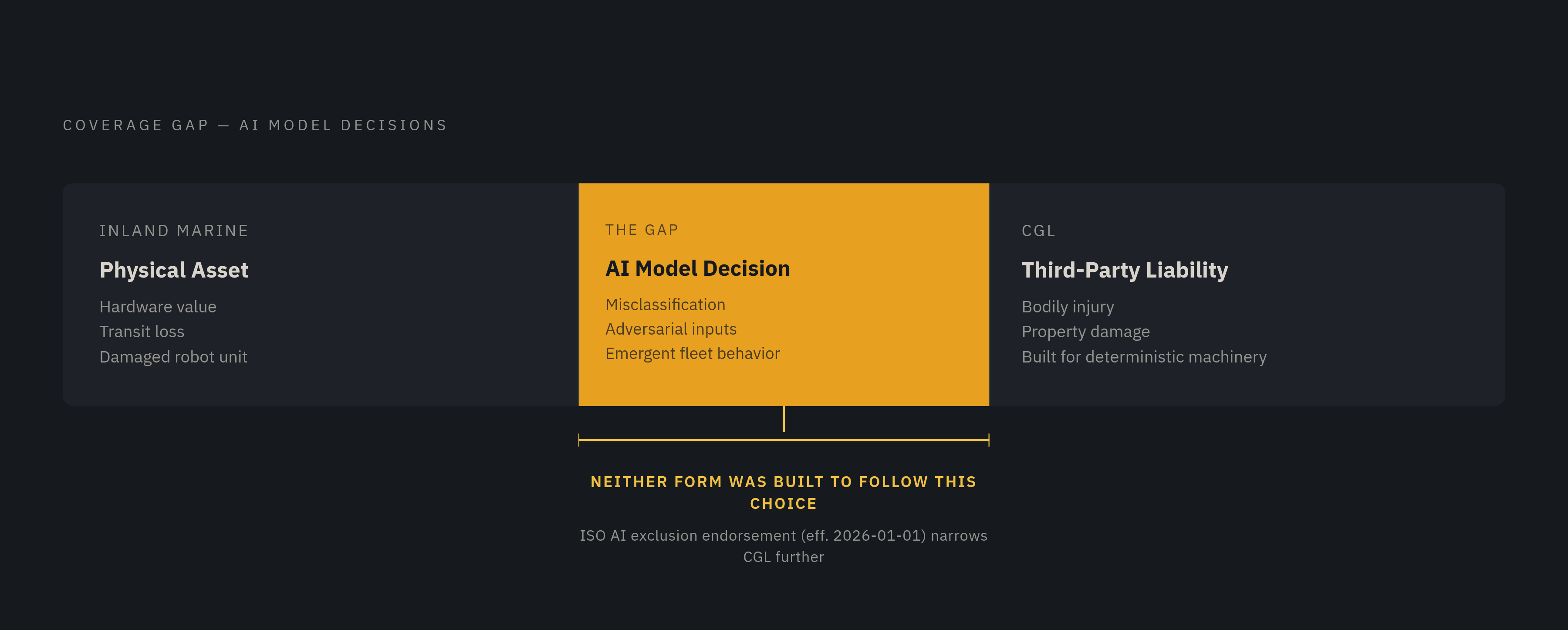
The structural gap lies in the model's decision, between the insured machine and the loss its action produces. Inland marine can recover the value of a damaged unit without addressing what it chose to do before being damaged. CGL addresses third-party injury and property damage, but its historical risk model does not expressly account for a learning system. When an applicable AI exclusion is added, that distinction can become an express boundary on recovery.
CG 35 08 illustrates the boundary precisely. It excludes bodily injury and property damage arising out of generative artificial intelligence within the Products/Completed Operations Coverage Part. It is not a blanket exclusion across all CGL coverage, nor does it specifically target every AI-directed physical operation. Nevertheless, where that coverage part would otherwise respond and the loss falls within the exclusion, the client-site injury may be outside coverage.
The fleet thus creates two simultaneous departures from a conventional equipment exposure. The hardware moves off-premises while the fleet's autonomous decisions create liabilities that the standard forms were not built to cover. A property policy that covers the loss may pay for physical damage without paying for the production losses that follow a line shutdown. Correcting a missing location or an omitted unit with a simple endorsement request leaves the autonomous decision-making exposure unresolved. If the AI model is making the consequential decisions, what policy form follows the model?
What client-site contracts require and what happens when the coverage behind the certificate has an AI exclusion
Enterprise procurement teams require certificates of insurance before deployment, but a certificate can describe policies that exclude the AI-related loss the client wants covered. The paperwork and the coverage can diverge. Evidence of equipment insurance and CGL does not answer whether the underlying contracts respond to an autonomous decision that causes injury, damage or operational loss. That question affects access to a site as soon as the client makes entry depend on meeting its insurance requirements.
Procurement teams are moving from policies that simply omit an AI exclusion toward affirmative AI-specific liability policies that explicitly cover AI mistakes. That coverage is difficult to obtain. Where it cannot be secured, contractual indemnification can become the alternative, with the vendor promising to pay out of pocket if its AI causes the enterprise a loss. The promise assigns the financial obligation to the vendor despite the insurance gap.
Government work adds requirements that vary materially by state, particularly for autonomous vehicles. California requires manufacturers to show a substantial minimum in insurance, a surety bond or self-insurance before testing or operating autonomous vehicles on public roads. Alabama mandates a minimum level of liability coverage for automated commercial trucks without a driver. Arkansas bases its minimum on federal motor carrier insurance requirements under 49 C.F.R. § 387.9, and the amount required depends on the type of vehicle.
The Connecticut Office of Legislative Research found that a substantial majority of states have laws specifically addressing liability coverage for operating or testing autonomous vehicles. Those requirements are distinct from the question of AI coverage. A required liability limit establishes an amount, while an exclusion can prevent a particular loss from reaching that amount.
The coverage lines designed to reach the AI model and how they fit together with inland marine and CGL
Technology errors and omissions insurance, or Tech E&O, follows the autonomy stack when the AI model is what the company sells or licenses. It addresses wrongful acts or performance failures tied to technology. That makes it the form capable of reaching the software failure itself, rather than only the damaged hardware or resulting bodily injury. Its role is complementary to inland marine and CGL.
A software error in a robot control platform can cascade into equipment damage, defective output or a facility-wide shutdown. Those losses can fall into gaps between property coverage and general liability. Tech E&O can cover the technology failure behind those losses, though what it pays for depends on the policy terms. The distinction is the object of coverage. Inland marine follows the robot as an asset, CGL covers third-party injury and damage within its terms, and Tech E&O follows the technology service or product that is said to have failed.
Cyber coverage can also cover AI-related losses when insurers add affirmative AI endorsements that reach those losses. That protection is not unlimited. An AI-related sublimit may be only a fraction of the cyber program's aggregate limit, so the headline amount can overstate the capacity available for an AI claim. Systemic-risk carve-outs can also exclude events in which one AI failure affects many policyholders at the same time.
Why the submission — not just the form — determines whether the AI model is actually covered
The insurer evaluates the autonomous system or the schedule of mobile equipment presented in the underwriting submission. The right forms are necessary but insufficient. A submission that omits the model's autonomy level, operating envelope and decision-logging architecture can lead to a policy that prices the robot like rented construction equipment and covers it accordingly. The description of operations must make the decision-making exposure visible.
Humanoid robotics and autonomous fleets have limited actuarial history, so underwriters are turning toward real-time, high-fidelity data logging to understand and price the risk. MCAP, or Message Capture, has emerged as a cornerstone of robotics data logging and replay. Its relevance here is the quality of the operating record available to underwriting. A technology label alone cannot replace a description of how the fleet operates within its intended envelope.
Granular fleet schedules provide a more useful basis for pricing than a vague narrative. Each robot's serial number, operating site, software version and autonomy level link the insured equipment to how and where it is used. Thin or incomplete submissions can signal adverse selection. The result can be a higher premium or no quote, rather than a program that accurately reflects the exposure.
The practical remedy is a specialist broker who builds the submission from operating data and reads the policies before they bind. That work connects the fleet's described behavior to the coverage being purchased. It also puts the forms, exclusions and affirmative grants in the same frame as the client's contractual requirements. A program follows the AI model only when the risk described to the insurer is the risk its wording agrees to cover.