How AI Model Liability Exposure Determines Which Commercial Policy Layer Must Anchor a Deployed Robot Fleet
Tech E&O with affirmative AI language must anchor robot fleet coverage.

Inland marine coverage for deployed robot fleets protects the physical robots in transit between job sites and at off-premises locations where standard property policies stop. It does not cover AI-model liability. For mobile robots operating across multiple locations, the insurance program needs separate asset and liability layers, with tech E&O containing affirmative AI language anchoring model-performance exposure rather than leaving that risk to general liability by default.
Why an AI model creates a distinct liability node in a deployed robot fleet
A robot in the field acts on a model’s decision, and something goes wrong. The resulting claim may concern the hardware, the decision itself, or the operator’s deployment of the system. Those are different paths to liability. A single incident can therefore trigger claims against the hardware maker, the AI model supplier, and the fleet operator, each with different insurance relationships. Finding the cause determines both whose name appears on the claim and which policy may cover it.
That distinction separates physical AI from machines executing fixed commands. Sensors, software, and models allow a robot to decide how to act as conditions change, so responsibility cannot always be traced to a command the operator supplied or a physical component that failed. Contracts divide those duties on paper. They do not eliminate disputes about which failure caused the loss, particularly when several parties contributed to the outcome.
The model’s legal treatment adds another uncertainty. Gallagher Re found that product liability may respond to injury and property damage from AI-driven failures, but only where applicable law, policy wording, and jurisdiction support treating the software as a product. That treatment is not universal and remains contested. Financial losses from the same failure can also fall outside coverage in many jurisdictions, while a flaw in a widely used model can affect businesses across geographic boundaries. The model can thus carry its own liability even when it runs inside someone else’s machine.
How the 2026 ISO exclusions changed the general liability baseline for autonomous operations
ISO’s January 2026 endorsements introduced standardized generative-AI exclusions into commercial liability forms. Their scope requires precision. CG 35 08 excludes bodily injury and property damage arising out of generative artificial intelligence under the Products/Completed Operations Liability Coverage Part. It is not, by itself, a blanket exclusion of autonomous systems or robotics from the main commercial general liability policy.
ISO/Verisk also introduced CG 40 47 for CGL, with CG 40 48 addressing Coverage B only. With these forms, insurers can use generative-AI exclusions across different coverage parts without having to rely solely on their own wording. For a fleet operator, the effect depends on the endorsement attached and the loss alleged. Autonomous operation and generative artificial intelligence are not interchangeable descriptions, so the existence of a standardized form does not establish that every robot incident is excluded.
Berkshire Hathaway, Chubb, and Travelers sought state regulatory approval to exclude AI-related damages from general liability policies, and regulators approved more than 80% of those requests. More than 60 property and casualty insurance providers filed for AI exclusions in their upcoming policies in 2026. The change extends beyond isolated placements.
These developments undermine reliance on “silent AI” coverage, where legacy wording neither expressly covered nor excluded the exposure. Silence is no longer a dependable foundation. A CGL policy containing an applicable generative-AI exclusion can remove bodily injury and property damage protection for the model-mediated event the fleet operator expected it to cover. Choosing the anchor policy therefore depends on what triggers coverage and what it excludes, even when the policy label is familiar.
What insurance covers mobile robots across multiple locations — and where does each layer stop?
Financial harm from an AI output or model error typically falls outside CGL even without the new exclusions. A generative-AI endorsement that applies to the loss can also limit coverage for bodily injury and property damage. Separately, a standard business policy may not respond if a robot loss does not meet its definition of an accident, and physical damage coverage does not necessarily include production losses from a downed robot.
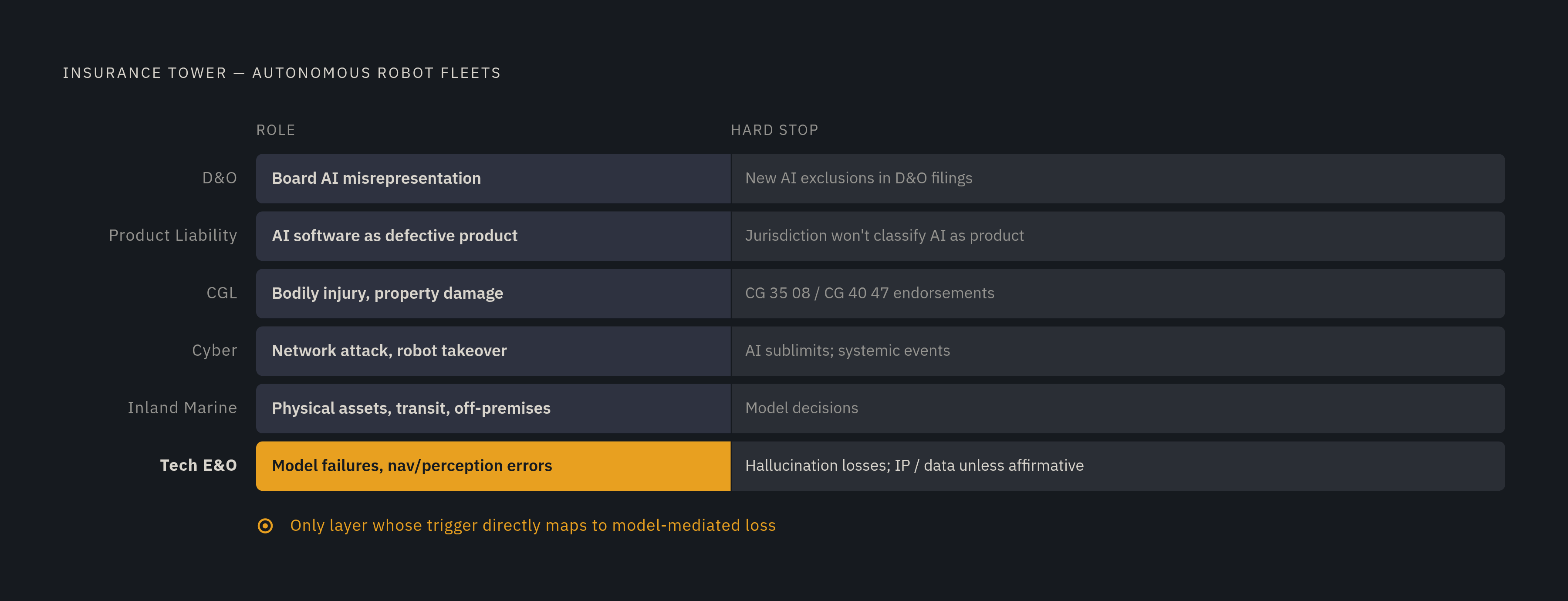
Tech E&O addresses wrongful acts or performance failures tied to technology, including gaps that general liability and cyber may leave open. But technology E&O forms can exclude hallucination-related losses, intellectual property infringement, and data disclosed through model outputs. An affirmative AI provision therefore has to be read against those restrictions rather than treated as a general promise to cover anything involving AI.
Cyber addresses the network-attack vector, including physical damage caused by an attack taking over a robot’s controls. Its limits can be narrower than they appear. Affirmative AI endorsements may cap AI-related coverage at a fraction of the cyber tower’s aggregate limit. Leung et al. describe foundation model concentration as a source of systemic risk, and carriers are adding carve-outs for cases where one AI failure affects many policyholders.
Inland marine addresses the fleet’s physical assets in transit and at off-premises locations. This is the distinction for robots moving between job sites. It covers an exposure that standard property policies may leave outside their location boundaries, rather than assuming responsibility for erroneous model decisions. Auto liability, cargo, and other property protection can each have their own role in the same program.
Product liability depends partly on jurisdictional treatment. The EU’s Product Liability Directive requires member-state transposition by December 9, 2026, and expressly treats software, including AI models integrated into commercial products, as a product subject to strict liability. Claimants must show defectiveness, damage, and causation. The directive bars contracts from limiting that liability to injured people and allows joint and several liability when more than one economic operator is liable for the same damage. Outside the EU, whether AI software qualifies as a product remains inconsistent.
D&O covers risks tied to how the company is run, separate from robot damage or model performance. Shareholders may allege that a board misrepresented the company’s AI capabilities or risk posture. AI washing can lead to this kind of misrepresentation claim. New AI exclusions in D&O filings mean that the relevant policy may not respond.
Why the anchor burden shifts to tech E&O with affirmative AI language — and what that layer must include
Tech E&O with explicit affirmative AI language must be the fleet’s main cover for AI-model performance exposure. Its wrongful-act or technology-performance trigger maps directly onto navigation failures, perception failures, and erroneous autonomous decisions. That is the structural reason for selecting it. CGL cannot be assumed to respond where applicable exclusions remove the loss, while cyber’s attack-oriented coverage, AI sublimits, and systemic-event restrictions make it an incomplete substitute.
The affirmative language must cover the ways the model can fail. Legacy E&O wording can exclude hallucination-related losses, infringement from model outputs, and disclosure through those outputs, even though each arises from the technology the policy appears to insure. Leung et al. distinguish four positions, namely affirmatively insured risks, silent-AI exposures, actively excluded risks, and risks outside conventional insurance. Their framework shows why the absence of an AI exclusion is not equivalent to an affirmative grant. The executed policy wording remains decisive.
Product liability presents the strongest objection to this anchor choice because it is the natural candidate for third-party bodily injury from a defective product. That role remains necessary where applicable law and wording support it. But its response to an AI model depends on the model’s legal treatment, whereas E&O’s performance-failure trigger does not depend on product classification in the same way. Anchoring model-performance exposure in E&O does not establish that every E&O form covers bodily injury, nor does it remove the need for product liability.
Inland marine protects physical assets, cyber covers network attacks, and product liability covers the chain of responsibility for injury where it applies. Specialist AI products also have per-insured limits well below litigation exposures already running into the billions. Stack construction and reinsurance access consequently remain important even when the anchor wording is sound.
How Bot Auto’s insurance placement illustrates what a structurally sound program actually requires to get off the ground
Bot Auto’s freight fleet between Houston and San Antonio shows the evidence needed to get insurance for autonomous operations. The fleet initially operated with safety drivers, with driverless operations on that corridor in progress. Its program combines auto liability, property, general liability, cargo, and inland marine protection, complemented by a separate cyber policy. Each layer has a defined role. The disclosed placement demonstrates a multi-layer structure.
What made the placement possible was the ability to describe risk through operational evidence. Bot Auto’s trucks generate consistent driving behavior, real-time data, and full traceability, reducing ambiguity around fault and improving loss investigation. Qualification required comprehensive risk mitigation beyond standard industry practices. Fleet size and revenue alone were not enough to establish the underwriting case.
The lesson for other operators is to support the coverage structure with comparable operational documentation. Real-time data, logs of vehicle behavior, and written safety parameters give insurers evidence when there is no autonomous-fleet claims history yet. Traceability also serves a purpose beyond pricing. In a dispute involving the hardware maker, model supplier, and operator, evidence of what the model decided and why can help distinguish a defensible allocation of responsibility from an unresolved causal dispute.
Why underwriting submission quality is itself a coverage determinant, not just a pricing input
The underwriting submission helps determine which risks receive coverage and which become exclusions. It is not merely a pricing form. Underwriters scrutinize training-data quality and documentation, model validation and testing, explainability, bias testing, audit trails, and contractual allocation of liability when model error causes harm. These details connect an insurer’s proposed wording to the operator’s actual exposure.
Structured governance can produce meaningfully better terms. A written AI Acceptable Use Policy, a documented inventory of fleet AI tools and their operating parameters, and an incident response plan serve both underwriting and enterprise procurement. They show the insurer how use is controlled and help customers judge whether the tools are deployed responsibly. Governance documentation consequently has both a financial function and a compliance role.
Pricing and coverage also reflect fleet revenue, the AI system’s criticality in the operational chain, data sensitivity, and governance maturity. Two operators can present materially different risks through their controls and documentation, even when the physical equipment is the same. A submission that obscures those distinctions can leave important exposures restricted.
The practical implication is to use a specialist broker who reads the forms before binding and builds the submission from operational data. That broker must identify carriers with explicit appetite for autonomous operations and examine sublimits that could leave gaps between layers. Broker commissions are built into the placement regardless. The broker’s work must therefore cover model liability even when the program already has the usual set of commercial policies.
How insurance requirements buried in enterprise and government contracts expose the gap between perceived and actual coverage
Enterprise and government contracts turn the layering decision into an immediate commercial obligation. Enterprise AI agreements often require third-party IP indemnity, terms for AI-specific liability, and minimum amounts of insurance. Standard general liability alone may not satisfy those requirements, particularly where an applicable exclusion removes the contemplated loss. An indemnity without adequate insurance backing leaves the financial obligation with the contracting party.
Government deployment adds another set of requirements. The Connecticut Office of Legislative Research found that 38 states have laws specifically addressing liability coverage for operating or testing autonomous vehicles. Minimums range from hundreds of thousands of dollars in some states to several million dollars in others. Nominal limits are only part of the test. A program can display the requested dollar amount yet fail to respond to the AI-mediated event for which the contract requires protection.
The coverage structure needs to be resolved before signing, ahead of renewal. The anchor policy’s trigger must respond to the model-related loss contemplated by the indemnity, while the other layers address physical assets, network attacks, and applicable product claims. This requires matching contractual obligations to actual wording. As autonomous deployment scales, the structure built today will either support enterprise and government commitments or leave them uninsured. Contracts are already being signed, and applicable exclusions are already in force.