Why the AI Liability Paper Trail Is the Inland Marine Underwriter's Real Risk Map for a Robot Fleet
Contracts, logs and incident records tell underwriters what asset schedules cannot.
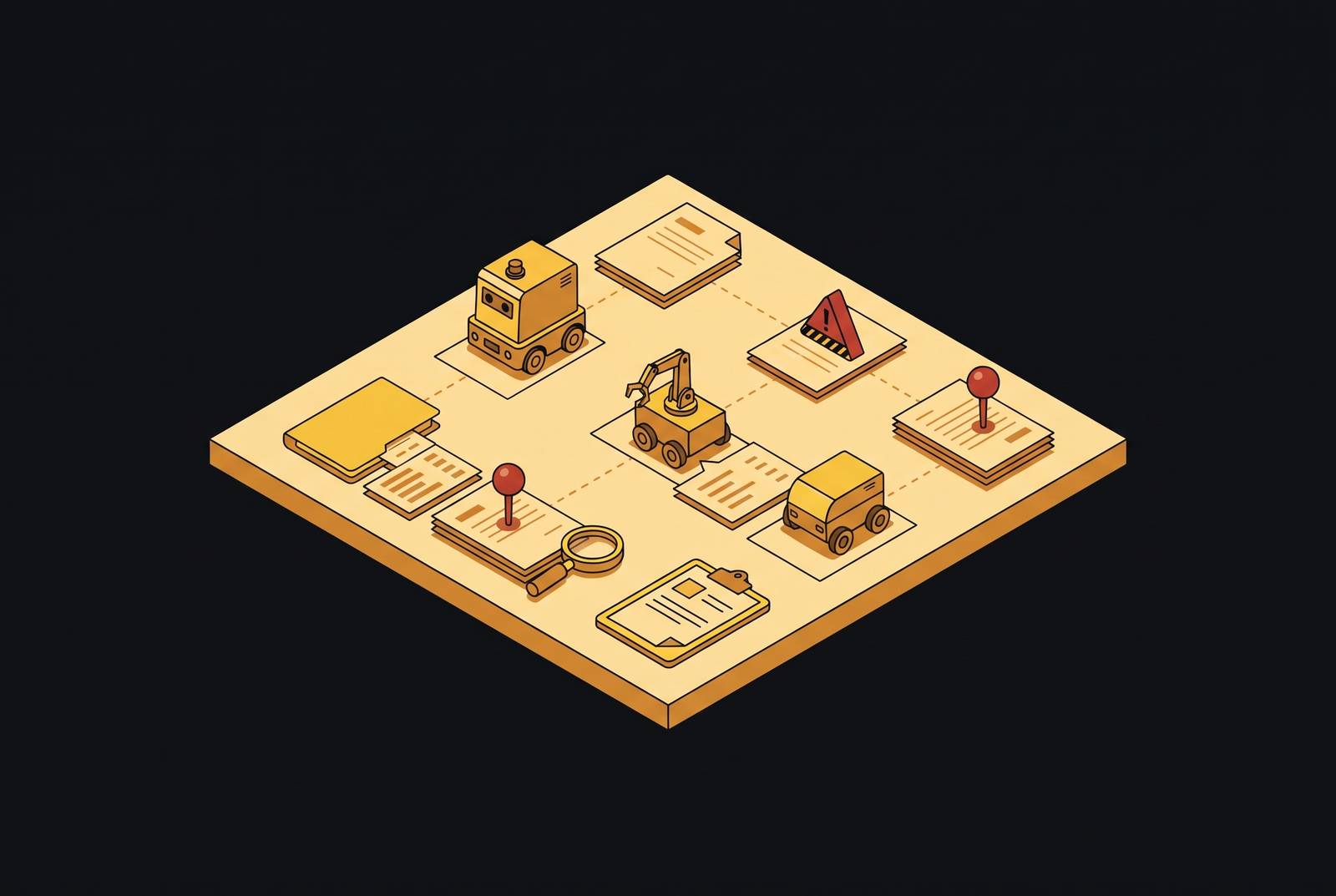
Inland marine coverage for deployed robot fleets is designed to cover risks to the physical equipment, including when it moves between job sites, under the policy terms. It does not by itself resolve liability from autonomous decisions. For a fleet operating across multiple locations, contracts, software records and incident evidence give the underwriter the risk map needed to price the equipment and structure the wider insurance program.
Why the physical asset schedule alone cannot price a robot fleet
The asset schedule on an inland marine underwriter’s desk records make, model, replacement value, location and operating environment. Those fields describe equipment that sits still or moves predictably. They remain necessary for a robot fleet, but they cannot describe how a machine chooses an action when conditions change.
Autonomous systems use sensors, software and AI models to choose actions. The risks they pose can change even when the hardware on the schedule stays the same. A replacement value tells the underwriter what the equipment is worth, while responsibility for an operating error among its manufacturer, model developer or operator requires other information. A location field also leaves out the rules for how people interact with robots at that deployment.
Before pricing begins, the underwriter must establish who owns each failure mode and whether the resulting loss is insurable under the proposed program. Physical damage to a robot and liability arising from its actions are distinct coverage questions. An asset schedule supplies the starting point for the former, but cannot settle the latter.
How a robot failure distributes liability across parties the asset schedule never names
WTW’s August 2026 analysis illustrates the problem through a humanoid robot dropping a heavy box on a contractor in a warehouse. The manufacturer may be responsible for a design flaw, while the software developer may be implicated if an algorithm misjudged balance. Inadequate safety procedures may implicate the operator, and a failed sensor may implicate the maintenance provider. One event reaches across several separate businesses. None of those relationships is explained by the robot’s replacement value.
Contracts divide those duties, but the division does not establish which failure caused the injury. Who is responsible under the contract also does not settle which insurance policy responds. An underwriter needs to see both the chain of responsibility and the coverage available at each point in it. Otherwise, an apparently straightforward equipment submission conceals unresolved liability.
OSHA guidance cited by WTW identifies programming, testing and maintenance as frequent settings for robot accidents. During that work, robots may start up unexpectedly because of control or state-management errors, while safety mechanisms may be bypassed for a time. These are not merely variations in the machine’s location. They are changes in its operating state that a standard submission may leave poorly documented.
A cyber compromise adds another possible cause. A compromised robot may disrupt operations, damage property or injure people, potentially bringing a cloud provider or connectivity vendor into the responsibility chain. The outcome alone makes it hard to tell where cyber, operational and physical risk begin and end. Before designing coverage, the underwriter needs to know who supplied each part of the system and under what rules the robot operated.
What the AI liability paper trail actually contains and why each document maps to a coverage question
Who is responsible for the component or model that failed? Contracts and integration agreements establish that chain and identify the obligations accepted by each party. They also expose liability caps, commonly tied to fees paid under AI vendor agreements, that may leave exposure with the operator. Additional-insured requirements, service-level obligations and uptime warranties raise separate coverage questions. Financial loss from those performance obligations is typically excluded under general liability and addressed under Tech E&O, subject to its terms.
Which model was operating when the loss occurred? Training data logs and model version records help show the technical history behind that answer, even if the software and operating limits have changed since the policy began. Records must remain usable after an update. Foxglove describes a “record once, read forever” approach associated with MCAP that preserves access to robot logs as the software changes. That continuity gives the underwriter a view of the robot’s perceptual health across its operating life.
What happened before the loss, and were safeguards active? Incident reports and near-miss logs show the operator’s own loss experience in a field with little actuarial history to draw on. They can also show whether safety mechanisms were active or bypassed during an event, which may affect compliance with coverage conditions.
What caused the action at the point of failure? Decision audit trails help tell an AI decision apart from a sensor input, human override or software update, which helps show who is responsible and which coverage line may respond. Without that distinction, an underwriter may price a worst-case allocation or add exclusions. AI governance policies and acceptable-use documentation add a record of how the system may be used and what operating controls are in place. Together, these records connect the robot’s conduct to the responsibilities declared in the application.
How the AI exclusion wave has made documentation the boundary between covered and uncovered losses
ISO issued three generative AI exclusions for commercial general liability in January 2026, namely CG 40 47, CG 40 48 and CG 35 08. Several carriers adopted them within weeks. CG 35 08 excludes bodily injury and property damage that arise from generative artificial intelligence from the Products/Completed Operations Liability Coverage Part. Evidence is needed not only to explain the risk, but also to establish whether proposed coverage addresses it.
The distinction between generative AI and autonomy is important here. A robot’s use of software or sensors does not, by itself, establish that a generative AI exclusion applies. Equally, describing the machine as industrial equipment does not establish that the exclusion is irrelevant. The model documentation and decision record must support the account of how the system operates. The actual endorsement, its placement and its wording govern what is covered.
This is often called silent cover. General liability, E&O and Tech E&O policies written before AI-specific products existed may contain exposure that was never expressly addressed. Exclusions remove that ambiguity in the carrier’s favor. But an operator that relies on an ordinary policy label may miss a large gap between the protection it expects and what it has bought.
Where an applicable exclusion removes losses arising from generative AI, missing evidence about the source of the robot’s action can prevent the operator from establishing that the loss falls outside that exclusion. Documentation can support a specialist underwriter’s assessment of an affirmative endorsement designed to restore excluded protection, using evidence of governance controls, model versions and incident audit trails. Whether that protection pays for a loss still depends on the policy terms and the facts of the loss.
What gaps in the paper trail actually cost — in premium, in structure, and in coverage terms
Incomplete records force an underwriter to make conservative assumptions about causes, responsibilities and controls. The resulting cost can appear in premium or take the form of lower limits, higher deductibles, added exclusions, narrower endorsements or stricter warranties and conditions. An operator may therefore receive a quote without obtaining the breadth of protection its operations require.
That distinction changes how quotes can be understood. A premium is attached to a particular allocation of risk. If uncertain AI exposure has been excluded, the price does not establish what affirmative protection for that exposure would cost. If a warranty imposes a condition the operator cannot document, the apparent placement also leaves an unresolved operational burden.
Lemonade’s per-mile pricing for Tesla Full Self-Driving shows how evidence can also bring the price down. Its model charges roughly half the per-mile rate when the system is engaged, using telemetry from Tesla’s Fleet API. This is a motor insurance example. Its relevance is narrower and concrete. Available, favorable behavioral and software data can support a lower rate rather than requiring the insurer to price uncertainty.
Specialist underwriting firms also use independent “insurance engineers” to align insurance with operational protection goals, reducing premiums while addressing coverage gaps. That approach depends on evidence detailed enough to distinguish the operation’s actual exposures. Missing records deny the underwriter that basis for differentiation. Complete records allow the proposed premium and coverage structure to be assessed against documented risk, with any discount remaining uncertain.
How enterprise and government contracts create a documentation floor that feeds directly into the submission
Enterprise and government customers often ask for insurance documentation before an operator prepares a specialist submission. Vendor reviews often call for Tech E&O, cyber and general liability certificates with the limits set out in the contract, along with additional-insured endorsements. These requests require the operator to describe its existing coverage structure. They also expose obligations that a generic equipment application would not capture.
Honigman warns that additional-insured status can give a false sense of protection. Being named on a vendor’s policy provides protection only to the extent that the underlying policy covers the loss. If relevant AI risks are excluded, the additional-insured designation does not restore them. Even with a certificate or a promise in a contract, the operator still needs to check the policy itself.
The same distinction applies to performance obligations. A customer contract may require uptime or other service commitments that create financial-loss exposure even when no robot is damaged and no person is injured. Those commitments need to be in the underwriting record because they affect how equipment protection, general liability and Tech E&O fit together. The contract is evidence of exposure.
Regulatory requirements add another layer of accountability. WTW’s analysis says the EU’s Product Liability Directive and AI Act hold manufacturers and operators more accountable for AI-enabled products and high-risk systems and call for more documentation from them. An operator that has assembled its contractual chain, liability caps, additional-insured obligations and compliance records already has the first layer of a credible submission. The remaining task is to connect that commercial record to the technical evidence of how the fleet operates.
What a submission built for autonomous operations looks like, and why a specialist broker is the difference
The practical submission framework follows from those connections. It retains the physical asset schedule, but adds a clear mapping of the hardware maker, model developer, integrator and operator, with each party’s indemnification obligations and liability caps stated. Software and model records establish what was running at policy inception. A protocol for notifying the underwriter of version changes then addresses the fact that the technical risk does not remain fixed throughout the policy period.
Incident and near-miss logs show what has happened while the fleet was at work. Even a short, honest record demonstrates internal reporting, while the absence of any log leaves the underwriter without that evidence. A written AI Acceptable Use Policy, an inventory of AI tools and an incident response plan explain the governance framework. These records also meet enterprise procurement needs alongside their use for insurance.
Operational context makes the technical record interpretable. Floor maps or deployment environments, human-robot interaction protocols, maintenance schedules and any third-party safety audits or certifications on hand show the conditions in which the fleet works. For mobile robots operating across multiple locations, that context complements the schedule’s location and operating-environment fields. It gives the specialist a basis for relating the equipment exposure to the wider liability program.
A specialist broker’s role is to translate this evidence into coverage questions and examine the policies that answer them. That includes finding carriers that offer affirmative robotics coverage, spotting exclusions such as CG 35 08 and guarding against reliance on silent cover.
The broker’s compensation is embedded in the carrier’s commission structure and included in the premium. For a founder or operator who is not an insurance expert, the work begins with records already maintained for safety, compliance and enterprise sales. The specialist’s job is to organize those records into a submission that supports coverage designed for autonomous operations. The policy terms decide what is covered.