How Inland Marine Policy Language Must Evolve When the Insured Peril Is Autonomous Behavior Not Just Physical Hazard
Insurers must rethink how inland marine covers autonomous equipment decisions.
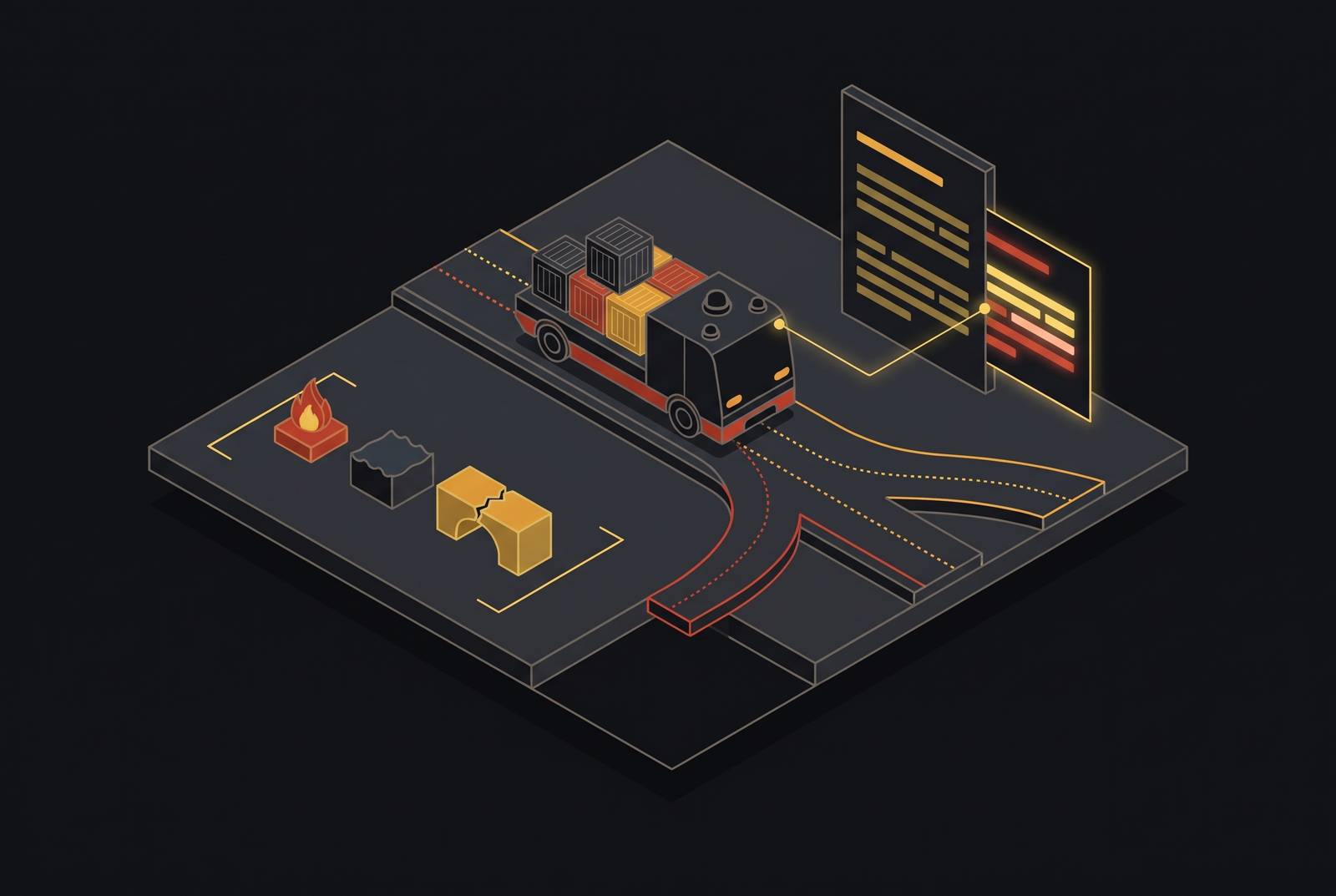
Inland marine is the natural coverage line for deployed robot fleets, including autonomous robots that travel between job sites and work in more than one location. But coverage for moving equipment does not, by itself, establish coverage for losses caused by that equipment’s decisions. Adequate protection requires policy language that expressly addresses decisional failures, responsibility for those failures, and the losses they produce.
Why inland marine policy language was never designed for a machine that decides
A standard inland marine schedule lists the equipment, while the policy sets out how it covers transit perils and physical damage to the insured property. Collision, theft, fire, and weather fit that structure. Each describes a physical event affecting an insured object, allowing the policy to connect the damaged property to a covered cause. The equipment is the passive object of the loss.
Autonomous equipment changes that relationship at its foundation. Its decision-making process can produce a loss at machine speed, without a human approving the action at the moment it occurs. The damage may look familiar, but its cause falls outside the assumption built into standard language that the property plays a passive role. This is a category mismatch rather than simply a shortage of limits or a missing endorsement. Commercial deployment in fields, waterways, and warehouses now exposes that mismatch at a scale the standard form was not designed to address.
How the assumption of human control is built into every standard form's peril definition
Traditional loss analysis assumes that a human remains in the decisional loop and that the resulting damage can be traced to a discrete physical event. Proximate cause links the loss to the cause that governs how coverage applies. Autonomous operation complicates the connection before the damage is valued.
Consider a robot whose perception model misreads sensor data, generates a navigation decision, and drives the machine into an obstacle. The collision is the physical consequence of the decision. Describing the claim only as collision damage leaves unresolved whether the controlling cause is the impact, the perception error, or the software-directed action. A peril definition concerned with what happens to equipment does not expressly resolve what happens when the equipment decides incorrectly.
The lack of real-time human approval affects more than how safely the machine works. Where policy language excludes autonomous operation without human oversight, that absence can become a coverage trigger rather than merely a detail in the loss investigation. Identifying physical damage does not settle how the policy treats its decisional origin.
What the ISO generative AI exclusion wave of 2026 did to the coverage that autonomous hardware operators thought they had
ISO introduced generative AI exclusion endorsement templates effective January 1, 2026, including CG 40 47, CG 40 48, and CG 35 08 for commercial general liability coverage. In early 2026, major commercial insurers began optionally adding AI exclusions to commercial liability policies at renewal. Adoption varied by carrier and state approval. Policyholders were not required to affirmatively consent to those additions.
That development gave contractual form to the retreat from “silent AI,” meaning AI risk potentially covered under older language that did not expressly address it. A renewal endorsement could introduce an explicit restriction where the policyholder had previously relied on an assumed grant of coverage. An operator whose broker did not flag the change could remain unaware of it until a claim.
The distinction between coverage lines remains essential, however. These CGL endorsements do not themselves change inland marine policies, and a generative AI exclusion should not be read as ruling out coverage for every autonomous function. Where liability language excludes a machine learning process and the inland marine form does not address its physical consequences, an automated picker directed into a wall can expose a gap between the policies. Neither the presence of hardware nor the fact of an impact resolves that gap.
What insurance covers autonomous robots traveling between job sites — and why inland marine still needs work
Inland marine was built to follow property in motion, making it the natural starting point for mobile robots deployed across locations. Its scheduled-equipment structure can list the hardware being insured without limiting the exposure to a fixed premises. It also has a history of adapting to unfamiliar property categories.
The cause and scope of loss remain unresolved even when the equipment category is recognized. A standard inland marine form may cover physical damage to a robot, while production stoppage, third-party property damage, or a software-driven navigation failure each raises different questions about what is covered. These are not interchangeable loss categories. CGL and tech E&O do not remove the need to define what the property policy itself promises when autonomous behavior damages the insured equipment or interrupts its use.
The gap persists because accepting new equipment on a schedule is different from rebuilding the policy around a new source of risk. A carrier can recognize the robot as property without expressly recognizing its decisions as covered causes of loss. At the same time, liability exclusions can narrow another source of protection before inland marine wording spells out coverage for these losses. The form is therefore well positioned to evolve, but its suitability for mobile property is not evidence that the necessary evolution has already occurred.
Three specific places in the inland marine form's architecture where behavioral risk has no address
Peril definition is the first location where behavioral risk needs an explicit place. It describes the causes of loss the policy covers. Physical-event language can identify a collision without expressly addressing the navigation model output that generated it. Nor does the label “all-risk” alone establish how the policy treats an algorithmic cause, particularly when exclusions or other definitions restrict coverage. The structural gap is the absence of a clear connection between decisional failure and the coverage grant.
Fault allocation is the second location, concerning how responsibility for the loss is assigned. An autonomous decision may implicate hardware, software, training data, and the operator. If the form has no way to sort out those overlapping sources of responsibility, doubt about the cause can lead to a disputed claim or denied coverage. The insured then faces a coverage question that the equipment schedule cannot answer.
Qualifying loss is the third location, defining which kinds of harm the insurer will pay for. Standard inland marine coverage centers on physical damage to scheduled property. A software update that takes a robot offline can produce production losses without damaging that property, leaving the physical-damage trigger unmet. Specialty programs are beginning to address such losses, but that response is not standard. Together, the three gaps can leave a loss without an expressly covered cause, a workable allocation of responsibility, or an eligible loss category.
What rebuilt inland marine language for autonomous systems would actually need to contain
The changes needed would build on what inland marine already does. The line has adapted from railroad cargo to aircraft parts and data center equipment. Autonomous hardware requires another adaptation, this time to the relationship between the property and the cause of loss. The policy must address decisions as well as objects.
At the peril-definition level, rebuilt language should expressly name perception errors, navigation model outputs, sensor-fusion failures, and software-directed actions that produce physical consequences. These belong beside traditional physical events in the coverage architecture. Broad residual wording leaves too much unresolved when the disputed issue is whether an algorithmic output is a covered cause. An express grant would give both the insured and the carrier a defined starting point for assessing that question.
At the fault-allocation level, the form needs a mechanism that addresses the hardware manufacturer, software developer, training data provider, and operator without requiring the insured to settle their respective responsibility before payment. That sequence is central to usable protection. A behavioral-fault framework analogous to products liability logic, but adapted for software-driven hardware, offers the direction for reform. The qualifying-loss definition must then expressly address production losses, downtime costs, and consequential losses from decision-driven failures, including those without physical damage. Clear exclusions for wear, intended behavior, and operator override would define the boundaries instead of leaving them to undefined residual coverage.
Underwriting must develop with the wording it supports. Equipment type and transit route alone cannot tell the carrier the autonomy level, how the human-override architecture works, what telemetry and audit-log availability it has, or how its deterministic safeguard design works. Policyholders must be able to demonstrate continuous telemetry tracking and automated intervention mechanisms, including safeguards against runaway execution cycles. The most sophisticated carriers expect evidence packages that include AI inventory documentation, written acceptable-use policies, monitoring and observability logs, and risk assessments mapped to frameworks such as NIST AI RMF or ISO 42001. Those materials make the behavioral exposure assessable.
How the submission process becomes the first place behavioral risk either gets covered or falls through
The underwriting submission can present autonomous behavior as an exposure or present only a collection of physical assets. The schedule may accurately describe the property while leaving the decisive feature of the risk undisclosed. That omission is especially consequential while standard language remains underdeveloped for autonomous systems.
For operators seeking behavioral coverage today, the submission should describe the system’s autonomy level, human-override design, telemetry and audit-log infrastructure, and deterministic safeguards against runaway execution. Vague product descriptions, undisclosed autonomy levels, and unclear data practices can produce narrower terms or denial because the underwriter cannot assess the exposure.
Submission quality is necessary, but it is not coverage. Even a detailed account of behavioral architecture does not replace an insuring agreement or override an exclusion. It enables the broker and carrier to address the exposure explicitly in the terms being offered. A specialist broker’s role is to connect that technical description to the policy’s peril definitions, exclusions, and qualifying-loss provisions. The result must be assessed in the issued wording.
What autonomous system operators should verify in their current inland marine coverage before the next renewal
Before renewal, operators should have a specialist broker check the current policy and submission against four specific questions. The first concerns the covered cause of loss. Does the peril language expressly address the system’s own decision-making, navigation outputs, or software-directed actions, or does it rely entirely on physical-peril descriptions and untested all-risk language. Silence on decisional risk is not an affirmative coverage grant.
The second question covers exclusions in the policies that could cover the loss. The review should find wording on autonomous operation, machine learning processes, or AI-directed physical actions and check how far it reaches. CG 35 08 is a generative AI exclusion for the Products/Completed Operations Coverage Part. It belongs in the wider coverage review, which must separate limits on liability coverage from the terms for damage to scheduled equipment. Similar words can have different effects in different forms.
Third, operators should verify whether production losses and downtime from software-driven failure qualify when no physical damage occurs. The answer needs to be explicit in the wording. The fourth is whether the carrier’s submission accurately describes autonomy level, human-override architecture, and telemetry infrastructure. A misdescribed risk can put the policy at risk of being voided when a claim arises, so verification must include the description on file as well as the contract issued from it.
Certificates do not substitute for this review at renewal. An inland marine certificate required by an enterprise or government contract confirms only that coverage exists. The renewal task is to establish what the current language grants, what it excludes, and whether the carrier received an accurate account of the deployed fleet. A specialist broker should run that verification without treating any specific loss as covered before the applicable terms have been examined.