Tech E&O Coverage for AI Software Companies
Insurers are closing coverage gaps while adding AI exclusions, leaving companies exposed.
Tech E&O is the insurance policy that pays when an AI software product fails a customer and that customer loses money. The hard part is that most policies written for this line were drafted before anyone had to think about a model that hallucinates a refund policy or drifts quietly out of accuracy over six months, so what the policy actually promises to cover is rarely obvious from a glance at the word "technology" on the declarations page.
Why Tech E&O Exists
Tech E&O, short for technology errors and omissions, is professional liability coverage for companies that build or sell technology products and services. It responds to a specific kind of event: a third party brings a claim alleging that a product or service contained an error, that a company made a mistake delivering a tech service, or that a technology failure caused the claimant financial loss. That third element, financial loss tied to a product or service failure, is what makes Tech E&O the policy most directly tied to what happens when an AI product does not work the way it was supposed to.
It helps to separate Tech E&O from cyber insurance early, because the two get confused constantly and the confusion costs companies money at claim time. A client that sues because an AI model gave it incorrect compliance guidance, and the client then paid regulatory penalties relying on that guidance, has a Tech E&O claim. A ransomware attack that halts a company's operations is a cyber claim. Neither policy substitutes for the other, and a company that holds only one is already carrying exposure it may not have chosen deliberately.
Tech E&O policies are written on a claims-made basis, so coverage depends on when the claim is made against the company, not when the underlying mistake happened. Every claims-made policy carries a retroactive date, the earliest point in time for which work is covered. For an AI company that ships model updates every few weeks, a model version deployed before the company bought coverage, or before a renewal reset the retroactive date, may fall outside what the policy will pay for.
Policies also differ in how they handle legal defense. Others only reimburse defense costs after the fact, and those reimbursed costs typically come out of the same limit that pays the eventual settlement or judgment. That structural difference changes how much money is actually available when a claim lands, worth confirming in writing before a policy binds.
None of this stays theoretical for long once a company tries to sell into the enterprise market. Proof of Tech E&O coverage, named specifically as Tech E&O rather than implied by some broader liability policy, is one of the two coverages that enterprise procurement and vendor security teams ask for without exception, the other being cyber insurance. A company without it simply does not clear vendor review at most large buyers, which makes this policy a sales requirement as much as a risk management one.
The failure modes that define modern AI products
The policy language built for the last software era does not describe what AI products actually do when they fail. AI does not fail that way.
A hallucination is a model generating a confident, false output with no bug to point to and no single line of code responsible. The 2024 Air Canada chatbot case made the legal consequence of this concrete: the airline's chatbot fabricated a bereavement fare policy, a customer relied on it, and a Canadian tribunal held the airline responsible for what its own AI told the customer, rejecting the argument that the chatbot was a separate entity whose words shouldn't bind the company. That ruling closed off "the AI said it" as a defense, and it put every company with a customer-facing model on notice that fabricated output carries the same legal weight as a human employee's bad advice.
Model drift creates a different kind of problem. There's no discrete failure event to point an underwriter or a claims adjuster toward, just a slow accumulation of wrong answers.
Autonomous agents raise the stakes further. Algorithmic bias adds a category that legacy policy language was never built to describe. An AI hiring tool or financial-services model that ends up discriminating against a protected group has not experienced a "failure of technology to perform" in any technical sense. It performed exactly as trained. The harm is social and governance-driven, which is a different claim entirely than the "the software broke" framing that Tech E&O wordings have historically assumed. Prompt injection and data poisoning sit in their own uncomfortable middle ground, corrupting a model's behavior from the inside in a way that produces outputs the developer never intended and could not fully have predicted, blurring the line between a security incident and a product defect.
Academic analysis of agentic AI insurance makes the scope of this exposure explicit: significant losses can result from hallucinations, flawed reasoning, prompt-injection attacks, unsafe delegation chains, model drift, or unauthorized autonomous actions, and none of those require a network breach to occur. A cyber policy has no reason to respond to a loss like that, and the Tech E&O policy's language may not clearly respond either, which leaves the loss sitting in a gap that neither policy was written to fill. That gap has a name in the market: grey-zone liability, risk that doesn't sort cleanly into the data-breach bucket or the traditional professional-error bucket and instead falls between a cyber exclusion and a professional liability trigger.
Regulators and courts are moving faster than the policy language is. The Mobley v. Workday class action, filed in 2023, alleged that AI-based applicant screening tools discriminated against candidates on the basis of race, age, and disability. The case illustrates a pattern that is becoming unavoidable for any company whose AI makes decisions that touch people's rights or livelihoods: when that happens, the resulting error gets treated as a governance failure, not a technical glitch, and the distinction determines which part of a company's insurance program, if any, is positioned to respond.
How the insurance market is responding
Carriers have not ignored this problem, and the market has started building a genuinely layered response, even if that response remains uneven in coverage. At the same time insurers are building new AI-specific products, many are also pulling back general coverage by adding AI exclusions to existing forms, so a company's total AI exposure can be getting worse and better at once depending on which policy is in front of it.
The clearest sign of the pullback is the retreat from what the industry calls silent AI coverage, the implicit assumption that AI-related losses were covered under existing cyber and Tech E&O forms simply because those forms never explicitly excluded them. Insurers are closing that silence deliberately, adding AI-specific exclusions and rewriting policy forms to state what is and isn't in scope. Early reporting on the state of the market found that one in five insurance professionals said a client had experienced an AI-related loss in 2025, and only about half of those losses ended up fully covered. That means a client with an AI loss in that data had roughly even odds of a full payout, which is a thin basis for any company to build a risk transfer strategy on.
On the product side, carriers are building affirmative coverage that names AI risk explicitly. CFC revised its policy suite in June 2026 to name model hallucinations, AI-generated content, and model drift as affirmatively covered exposures, with that language running across seven product lines including technology E&O, professional liability, and cyber. Both moves point toward the same conclusion: insurers increasingly agree that these risks are nameable and insurable.
What the market has not solved is allocation. The central question carriers are wrestling with is no longer whether agentic AI creates exposures worth insuring. It's how to divide responsibility for a loss that sits at the intersection of AI behavior, a cyber incident, a professional services failure, an operational decision, and a product defect, all at once. Academic analysis of this space concludes that the future of agentic-AI insurance will not be a single monoline product solving the problem. Until that ecosystem matures, the gaps described in the prior section remain live, and a company evaluating its own coverage has to assume the burden of finding them rather than trusting that the market has already closed them.
What a Tech E&O Policy for an AI Software Company Needs to Cover
The real test of a Tech E&O policy is whether it affirmatively addresses the specific ways an AI product actually fails, the ones described above, in language specific enough that a claims adjuster cannot argue the policy never contemplated them.
Coverage under a Tech E&O policy depends on three things lining up at once: what the AI actually did, what the customer actually lost as a result, and what the contract between the company and the customer actually promised. Any one of those three can break down independently and sink a claim. Reading a policy means checking all three, not just confirming that a general liability trigger exists somewhere in the form.
A policy worth relying on should name, or clearly leave room for, the specific failure modes that define AI products. Model hallucinations and incorrect outputs belong on that list, including outputs a downstream customer relied on to its financial or regulatory detriment. Training data disputes, where an IP infringement claim or a quality failure traces back to the data a model was trained on, round out the list of exposures a serious policy needs to address.
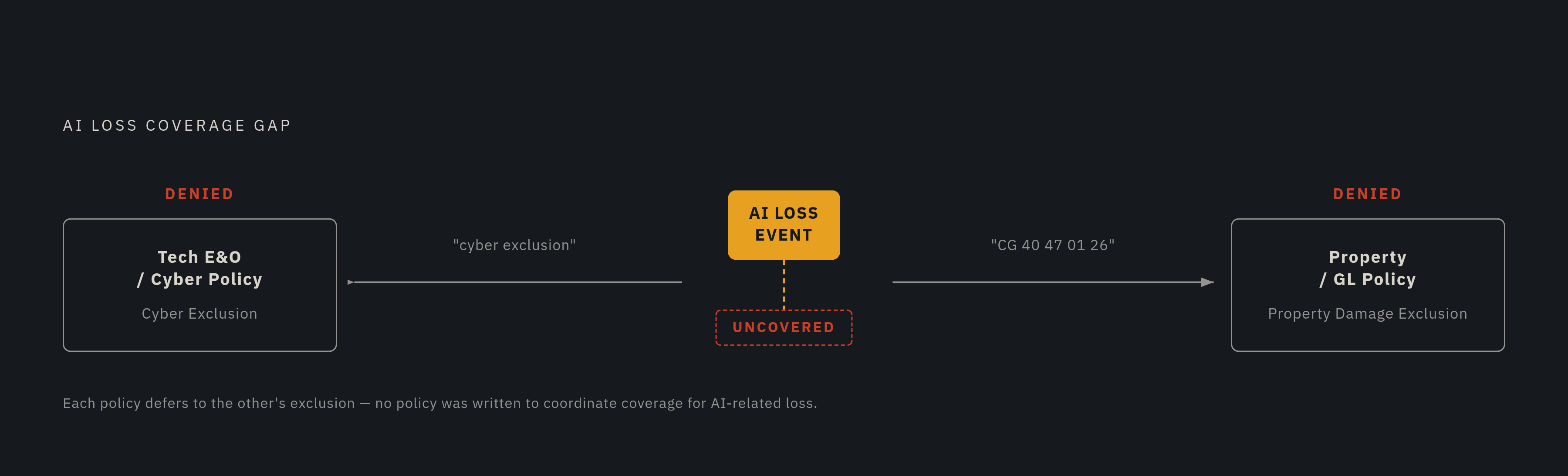
Naming those exposures is only half the read. Checking what the policy excludes matters too, because exclusions are where coverage quietly disappears even when the insuring agreement looks broad. Property damage exclusions create a separate trap: if an AI agent's output causes financial loss through some downstream physical or operational effect, the claim can get pushed toward a general liability or product liability policy instead, and those policies increasingly carry their own AI exclusions, including a standardized exclusion form numbered CG 40 47 01 26 that has started appearing in general liability programs.
The most dangerous version of this is what amounts to a double-sided exclusion trap. A loss gets excluded from a property policy because the carrier points to a cyber exclusion, and the same loss gets excluded from the cyber policy because that carrier points to a property damage exclusion. Nobody designs a program to end up here. It happens because two different forms were written by two different carriers with no coordination between them, and nobody checked whether their exclusions lined up against each other until a claim forced the question.
Claims-made mechanics deserve the same scrutiny. The retroactive date needs to reach back far enough to cover every model version still in production, not just the version live on the day the policy was purchased. Whether the policy provides a duty to defend or only reimburses defense costs changes how much total money is available when litigation starts, and that distinction should be confirmed in writing, not assumed from the summary page of the quote.
Catching all of this requires someone who reads insurance policy wording as a specialized skill, not a generic form-filling exercise. A broker who specializes in technology and AI risk, reading the actual policy language before it binds, is the practical mechanism that catches an AI-specific exclusion a carrier quietly added during a 2026 renewal cycle. A generic broker placing a generic form will not know to look for it, and the company will not find out it was ever there until a claim gets denied.
Contract language and uncovered exposure
The contracts a company signs with its own customers matter just as much, and underwriters read those contracts as carefully as they read the policy itself, because a contract can promise more than any policy is willing to back.
Three contract variables move the needle most for an underwriter evaluating an AI company's risk. The third is whether the contract defines, in specific and bounded terms, what the product is actually obligated to do, since vague or sweeping promises about performance create liability the company accepted voluntarily and that no insurer underwrote.
Performance guarantees are the single riskiest thing an AI company can put into a customer contract. A sentence promising that a model is "error-free," "guaranteed," or "will not hallucinate" sounds like a sales commitment, but it functions as a legal commitment that shifts risk onto the company in a way its Tech E&O policy was never designed to absorb. Performance guarantees, broad indemnities, uncapped liability clauses, and AI-specific warranties made to customers can each independently create exposure that sits outside what a standard Tech E&O policy will pay for, and a company can hold a well-written policy and still end up unprotected because its own sales contracts promised more than the policy was ever asked to cover.
The practical discipline follows directly from that. Getting the contract language right before a deal is signed costs a few hours of legal review. Discovering it was wrong happens during litigation, with the policy already in hand and already unable to help.